Pool with Two Figures: The Hockney Painting That Broke Auction Records
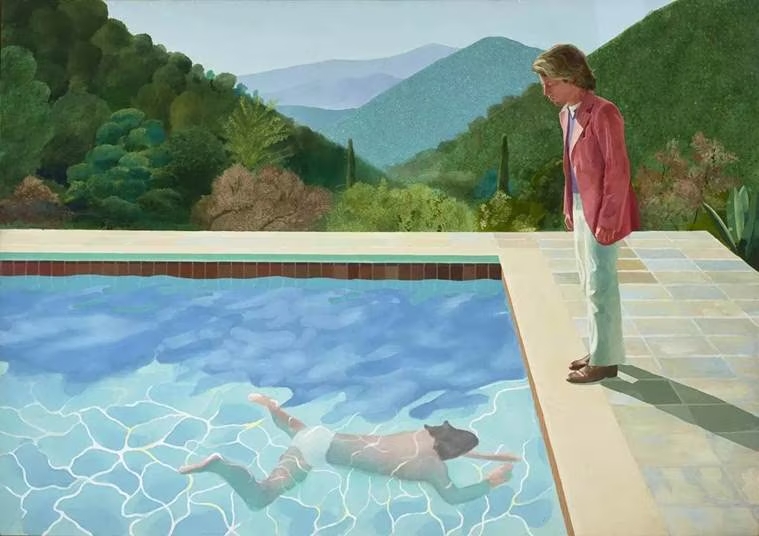
“Pool with Two Figures” — or by its full title, Portrait of an Artist (Pool with Two Figures) — is one of those paintings everyone has seen, even if they don’t know the name. A man in a pink jacket standing at the edge of a swimming pool. Another man, swimming underwater, frozen in mid-stroke. The water, painted with that signature Hockney shimmer that’s been imitated a thousand times and never quite matched.
In 2018, this single canvas sold for $90.3 million at Christie’s, making David Hockney the most expensive living artist in the world at that moment. But the price isn’t the most interesting thing about it. The story behind the painting — the breakup, the destroyed first version, the desperate two-week sprint to finish — is a small masterpiece in itself. In this article we’ll walk through how the painting was made, what it actually means, why it keeps showing up in popular culture, and what it’s worth today.
The Story Behind Portrait of an Artist (Pool with Two Figures), 1972
The painting was made in 1972 in Hockney’s Los Angeles studio, but its story really starts a few years earlier — and several thousand miles away.
In 1966, Hockney met a young art student named Peter Schlesinger in California. Peter was eighteen. Hockney was nearly thirty. They became lovers and creative partners. Schlesinger appeared in dozens of Hockney’s drawings and paintings throughout the late 1960s.
By 1971, the relationship was over. Schlesinger had ended things, and Hockney was, by his own admission, devastated. He spent months unable to recover.
The painting that became “Portrait of an Artist” started as a way to process the loss. But the first version went terribly wrong. Hockney spent six months working on it and ultimately destroyed the canvas in frustration.
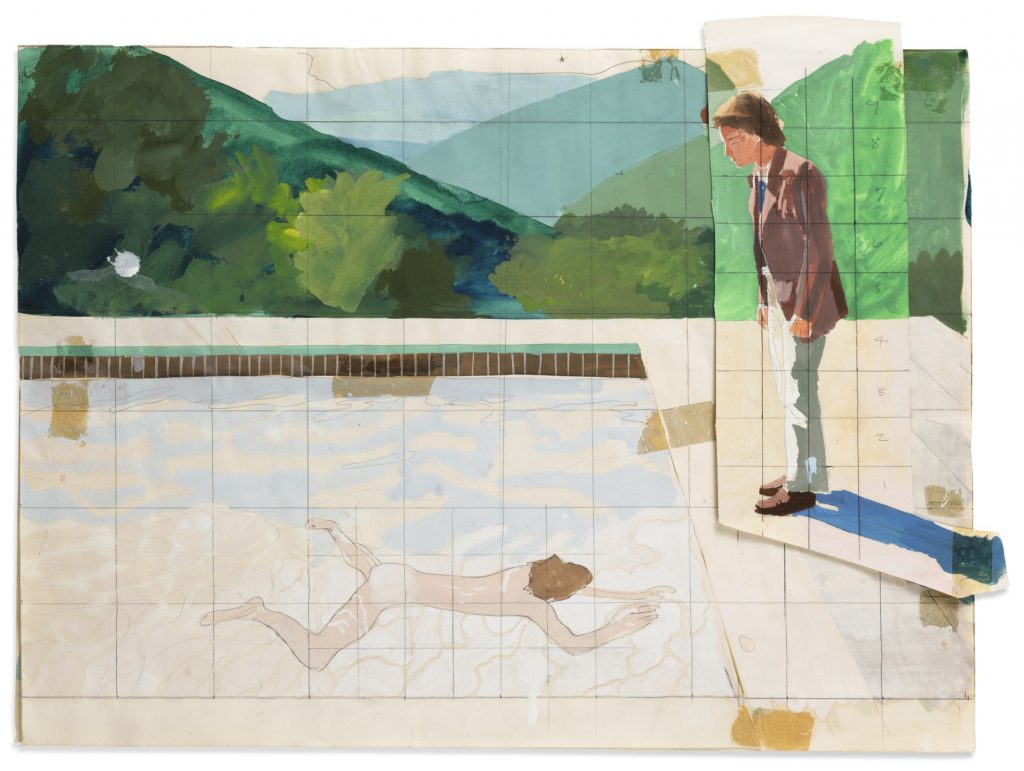
The breakthrough came almost by accident. Hockney was looking through a stack of old photographs and noticed two unrelated images side by side on his studio floor:
- A photo of a swimmer underwater
- A photo of a boy looking down at the ground
That accidental juxtaposition gave him the entire composition. The two figures didn’t need to be in the same room — they needed to be in the same pool, separated by water and gravity and time.
He restarted the painting in May 1972 with one urgent deadline: an exhibition at André Emmerich Gallery in New York that opened in late May. Hockney finished the canvas in roughly two weeks of intense work — flying photographer John St Clair to the south of France to shoot reference for the pool, painting twelve to fifteen hours a day. The final figure on the deck was modeled by Schlesinger himself, who agreed to pose for the work that was, in many ways, about him.
Pool with Two Figures Meaning and Symbolism
There’s a reason this painting has stayed in the cultural conversation for over fifty years. It’s not just beautifully made — it’s saying something almost too clearly to articulate.
A Portrait of Love, Loss, and Distance
The composition is heartbreaking once you see what it’s doing.
Two figures share a single frame. One stands fully clothed at the edge of the pool, looking downward. The other swims below the surface, captured mid-stroke, oblivious to being watched. They occupy the same space. They cannot see each other.
That’s the entire emotional engine of the painting:
- The standing figure looks down at the swimmer with something between longing and resignation
- The swimmer keeps moving, indifferent, in his own world beneath the water
- The water itself becomes the barrier — beautiful, transparent, but absolutely separating the two
It works because it doesn’t insist on autobiography. You don’t need to know about Hockney and Schlesinger. Anyone who has ever loved someone who has stopped loving them back recognizes the image immediately.
The painting takes a private breakup and turns it into a universal statement about distance — the kind that exists between two people standing close enough to touch.
Pool with Two Figures Analysis: Composition and Visual Language
The formal qualities of the painting are just as striking as its emotional content.
Key compositional elements:
| Element | Function |
|---|---|
| Horizontal split | Pool deck above, water and swimmer below |
| Standing figure on the right | Stable vertical anchor in pink jacket |
| Underwater swimmer | Diagonal, dynamic form cutting through blue |
| Mountain backdrop | Distant landscape grounds the scene in place |
| Mediterranean palette | Pinks, greens, blues — sun-soaked but cool |
Hockney’s painted water deserves a chapter of its own. He spent years figuring out how to depict water in a way that felt true rather than literal. The surface ripples are stylized white lines. The submerged body is gently distorted — limbs slightly stretched, edges softened — exactly the way water bends light in real life.
The whole composition is a study in what painting can do that photography can’t. A photograph would have to choose: focus on the swimmer or focus on the figure on the deck. Hockney can give you both, sharply, in the same frame, with each figure occupying a different reality.
That’s the trick of the painting. It doesn’t just show distance. It enforces it.
Hockney’s Swimming Pools Series and Artistic Context
To understand why “Portrait of an Artist” hits so hard, you need to know the context it grew out of.
Hockney moved to Los Angeles in the mid-1960s and immediately became obsessed with two subjects: the city’s young men and its swimming pools. The two were often combined.
Earlier pool paintings include:
- “Peter Getting Out of Nick’s Pool” (1966) — joyful, sunlit, his lover Schlesinger climbing out of a friend’s pool
- “A Bigger Splash” (1967) — the iconic image of a diving board and the explosive splash, no figure visible
- “Sunbather” (1966) — a male nude lying on a pool deck, blissfully self-contained
- “Pool and Steps, Le Nid du Duc” (1971) — a quieter image, no figures, just architecture and water
These earlier works are essentially celebratory. California as paradise. Pools as sites of pleasure. Young male bodies as objects of affectionate attention.
“Portrait of an Artist (Pool with Two Figures)” changes the tone completely. The pool is still beautiful. The light is still gorgeous. But for the first time, there’s a story being told, and the story is sad.
It’s the moment when Hockney’s California period grows up. The hedonism doesn’t disappear, but it acquires weight. The same setting that hosted joy can also host loss — and the painting holds both.
Cultural Impact and References
Some paintings live mostly in art history books. Others escape into the wider culture. “Pool with Two Figures” did the second thing.
Pool with Two Figures in BoJack Horseman and Popular Culture
If you watched BoJack Horseman, you’ve seen the painting — even if you didn’t realize it.
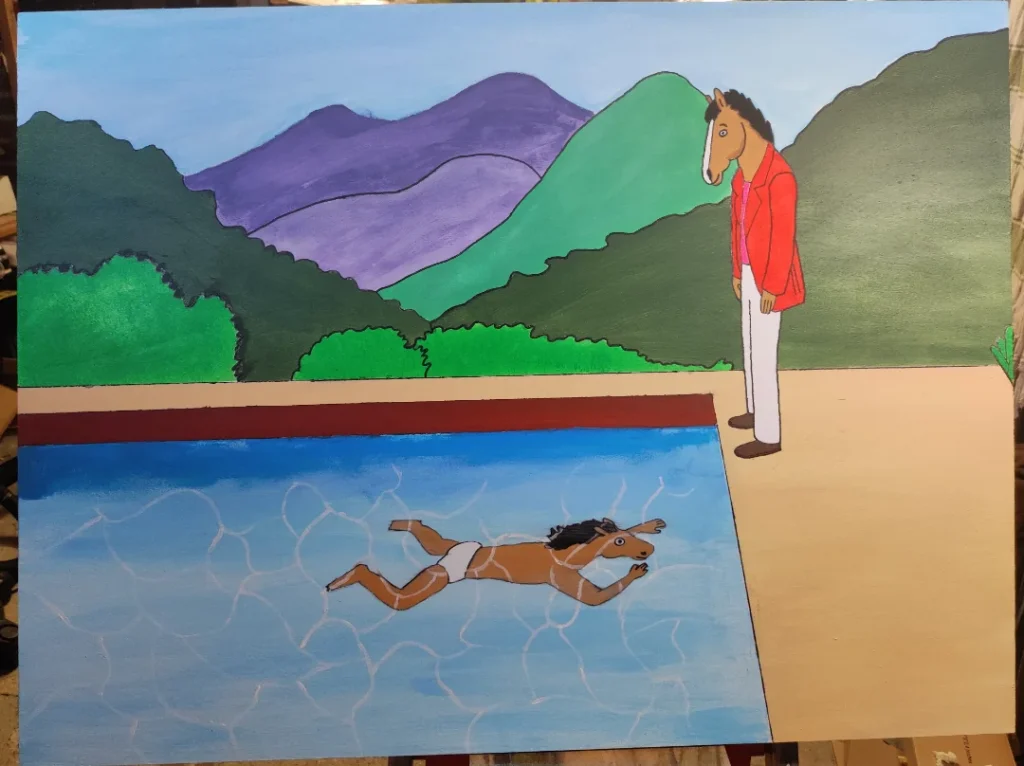
The Netflix animated series, set in a fictionalized Hollywood, features the painting prominently in the opening credits and various interior scenes. BoJack himself is shown floating face-up in a pool, in compositions that directly echo Hockney’s underwater swimmer. The visual quotation is constant throughout the series.
The choice was deliberate. BoJack Horseman is a show about isolation, regret, and the impossibility of genuine connection in a world full of beautiful surfaces. Hockney’s painting does exactly the same work, fifty years earlier, in a single frame.
Other cultural appearances include:
- Fashion editorials — pool shoots regularly reference the composition
- Album covers and music videos — the visual vocabulary keeps reappearing
- Film references — independent cinema using the painting’s composition for emotional shorthand
- Advertising campaigns — luxury brands evoking the Hockney aesthetic for sun-soaked sophistication
This is why a younger generation that may not know much about contemporary art still recognizes the image immediately. Hockney’s pool has become a piece of shared visual language for melancholy and emotional distance.
Reproductions, Posters, and Collecting the Image
You cannot, obviously, buy the original — it sits in a private collection and last sold for $90 million. But the painting is one of the most reproduced images in contemporary art.
Where to find quality reproductions:
- Tate shop and major museum stores — high-quality officially licensed prints
- David Hockney Foundation–authorized editions — the most accurate color reproduction
- Christie’s and Sotheby’s exhibition catalogues — published images at print quality
- Specialist art-book publishers — Thames & Hudson and Taschen monographs
What to look for when buying a poster or reproduction:
- Color accuracy — Hockney’s blues are very specific; bad reproductions push them toward green or purple
- Paper and printing quality — matte fine-art paper holds the image far better than glossy stock
- Licensing information — official editions usually note the publisher and rights
- Size and proportion — the original is roughly 7 x 10 feet; quality posters maintain that ratio
A practical tip: avoid mass-market posters from generic poster sites. The color reproduction is almost always poor, and the resolution often softens key details like the underwater figure and the surface ripples. Pay a little more for a museum-shop edition or a properly printed exhibition poster — the difference is immediately visible.
Auction History and Pool with Two Figures Price
The auction story of “Portrait of an Artist (Pool with Two Figures)” is itself a piece of art-market history.
Key sale data:
| Year | Sale | Price | Significance |
|---|---|---|---|
| 1972 | André Emmerich Gallery | ~$18,000 | Original sale shortly after exhibition |
| 1995 | Sotheby’s London | $2.5 million | Strong but modest growth |
| 2018 | Christie’s New York | $90.3 million | World record for a living artist |
The 2018 sale was historic for several reasons:
- It made Hockney the most expensive living artist at the time of the auction (later surpassed by Jeff Koons’s “Rabbit” in 2019, then again by Hockney in subsequent sales)
- It was a guaranteed sale, but the final hammer price exceeded expectations
- The painting had been off the public market for years, held in a major private collection
- Bidding was intense, with the work selling above its high estimate
Why did this particular Hockney command such an extraordinary price? Several factors:
- Iconic status — instantly recognizable, museum-quality image
- Rarity — most major Hockney paintings are in institutional collections
- Cultural resonance — over fifty years of accumulated meaning
- Provenance — the chain of ownership included serious collectors
- Condition — the painting has been carefully preserved
- Hockney’s market moment — major retrospectives at the Tate and the Met had just driven international attention
Among the previous owners is American media mogul David Geffen, who held the painting for years as part of his renowned modern art collection. The painting changed hands several times before its 2018 record sale.
What makes “Portrait of an Artist (Pool with Two Figures)” continue to matter, more than fifty years after Hockney finished it in a frantic two-week sprint, isn’t the price tag. It isn’t the BoJack Horseman cameo. It isn’t even the technical brilliance of the painted water, though that alone would secure its place in art history.
It’s that the painting tells the truth. About California and its surfaces. About love that’s already over while one person is still standing there. About the strange way you can be physically close to someone and absolutely separated from them at the same time. Hockney took something private and painful and turned it into something universal — without a trace of self-pity, without raising his voice.
That’s why people keep coming back to this image. The pool is just a pool. The two figures are just two figures. But together, in that exact arrangement, they say something almost everyone has felt and almost nobody can put into words. The painting does it for us.
Frequently Asked Questions
The painting sold for $90.3 million at Christie’s New York in November 2018, setting the world auction record for a living artist at the time. Its current market value is estimated to be even higher today, given Hockney’s continued institutional recognition and the painting’s iconic status, though it has not been resold since that sale.
The painting is about emotional distance and the end of a relationship. It depicts Hockney’s former lover Peter Schlesinger standing fully clothed at the edge of a pool, looking down at a swimmer underwater. The two figures share the same space but cannot truly see each other, with the water acting as a barrier — a visual metaphor for love that has cooled and connection that has been lost.
Damien Hirst is generally considered the wealthiest living artist, with an estimated net worth exceeding $1 billion thanks to his controversial production model and global market reach. Other extremely wealthy living artists include Jeff Koons, Jasper Johns, and David Hockney himself, all with net worths in the hundreds of millions of dollars.