Conrad Jon Godly: The Swiss Painter Whose Mountains Drip Off the Canvas
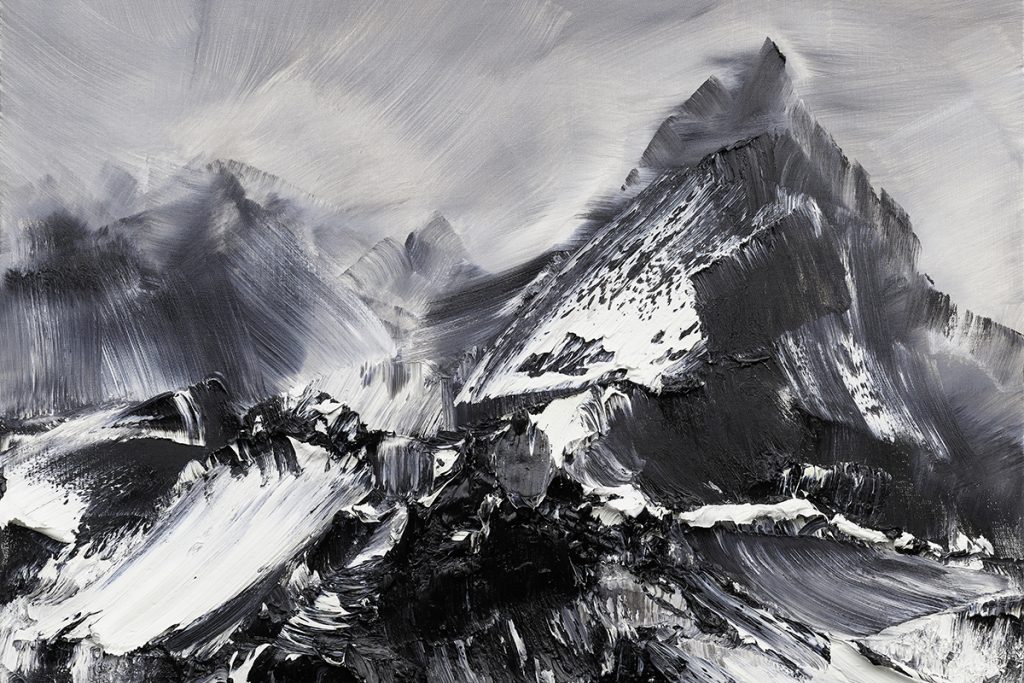
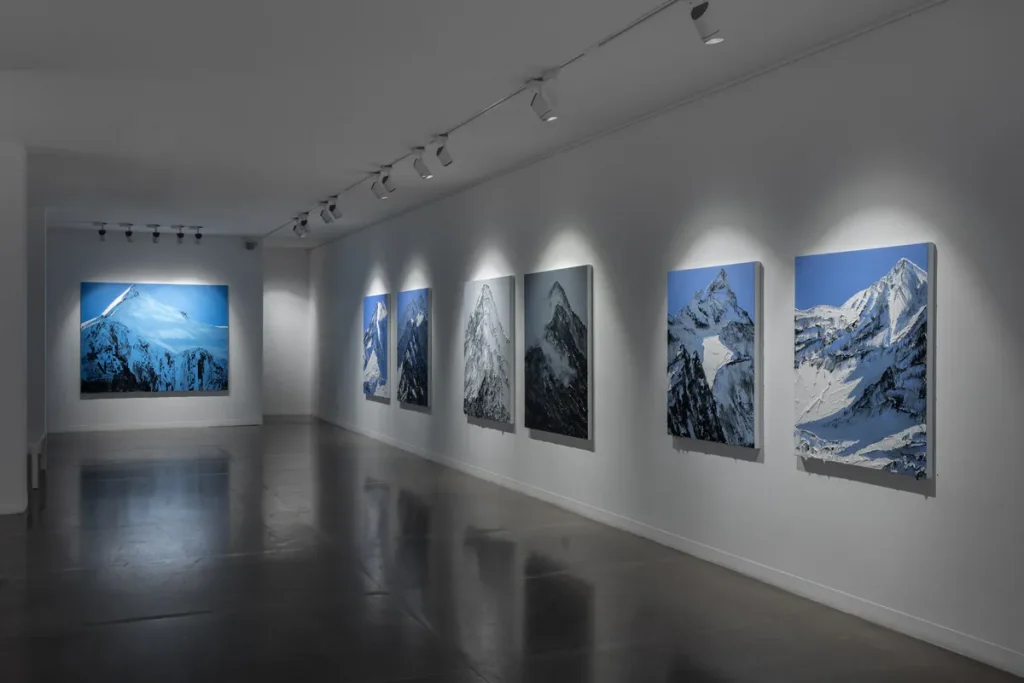
Conrad Jon Godly paints the Alps the way nobody else does. His canvases aren’t really paintings in the usual sense — they’re closer to small geological events. Oil paint piled centimeters thick. Heavy ridges that catch the light from across a room. Drips frozen mid-fall down the surface, like glaciers that forgot to keep moving.
Stand in front of one and the trick becomes obvious: at a distance you see a mountain. Step closer and the mountain dissolves into pure matter. Step closer still and you realize the paint itself has the weight and texture of rock. In this article we’ll walk through his biography, his unusual technique, the major themes in his work, and what his paintings cost on the contemporary market.
Biography and Artistic Journey
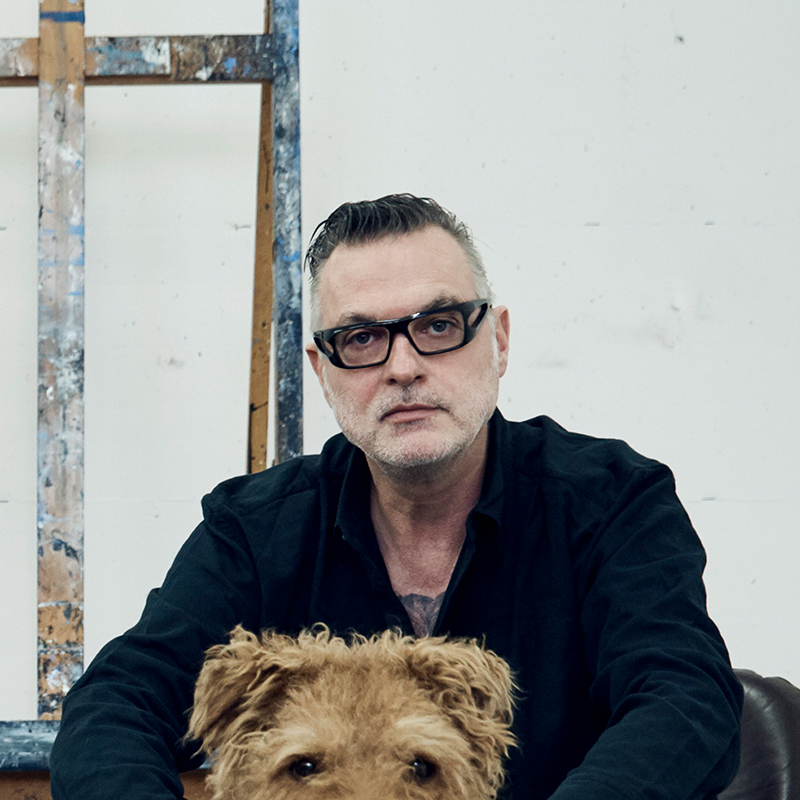
Conrad Jon Godly was born in 1962 in Davos — yes, that Davos, the Swiss Alpine town better known today for hosting the World Economic Forum than for producing painters. He grew up at high altitude, surrounded daily by the peaks that would eventually become his only subject.
He studied at the School of Design in Basel during the 1980s, in the painting department. Solid academic training, classical foundations.
Then came an unexpected detour. After graduating, Godly didn’t pursue a painting career. Instead he spent nearly two decades working as a successful commercial photographer in Zurich. He shot fashion, advertising, editorial — the kind of polished, well-paid work that fills magazines and billboards.
Around 2005 he made the decision that defines his career today. He walked away from photography entirely and went back to painting full-time. Not just any painting — only mountains.
The trajectory since then:
- 2005 — return to full-time painting, retreat from commercial photography
- 2008–2010 — first solo exhibitions in Switzerland, signature impasto style fully developed
- 2013 — international breakthrough, exhibitions in Asia and the US
- Mid-2010s — collaborations with luxury brands and architects
- Present day — represented by major galleries in Switzerland and abroad, works in private collections worldwide
His studio is in the Swiss countryside, far from the urban art-world circuits. He paints slowly. He doesn’t post much. The work speaks for itself.
Conrad Jon Godly Mountain Paintings: A Signature Vision
Almost everything Godly has painted in the last twenty years is a mountain. Sometimes recognizable peaks. Sometimes pure invention. Always the same essential subject.
That sounds limiting. It isn’t. Within that single motif he explores an enormous range:
- Vertical compositions — single peaks rising out of dark valleys
- Horizontal panoramas — chains of mountains stretching across the canvas
- Close-ups — fragments of slopes pushed almost to abstraction
- Storm-light variations — same form rendered in different atmospheric conditions
The genius is in how the paintings sit between abstraction and figuration. From across the room they read clearly as landscape. Up close they become pure painterly matter — peaks and valleys made not just of pigment but of physical paint mass.
That oscillation is the whole point. Godly is asking what painting is. Is it an image? Is it a thing? His answer: both, depending on where you stand.
The Impasto Technique and the Weight of Paint
Godly’s technique is what separates him from every other landscape painter working today.
Most painters use oil paint as a thin medium — diluted, brushed, layered carefully. Godly uses it almost like clay. He piles it on with palette knives in massive quantities, building up ridges that can protrude three, four, even five centimeters from the canvas surface.
What this looks like in practice:
| Element | Detail |
|---|---|
| Paint application | Palette knife, often direct from the tube |
| Paint thickness | Up to 5 cm of relief from the canvas plane |
| Drying time | Months, sometimes longer for the heaviest works |
| Drip technique | Oil paint allowed to run down the canvas while still wet |
| Final surface | Part painting, part low-relief sculpture |
The drips are crucial. Most painters work hard to control runs and drips. Godly invites them. He lets gravity pull paint down the surface, creating vertical streaks that read as either rainfall, melting snow, or simply the material’s own desire to fall.
There’s also a beautiful conceptual rhyme at work. Mountains are made of accumulated rock — minerals piled up over geological time. Godly’s paintings are made of accumulated paint — pigment piled up in the studio over weeks. The technique isn’t just descriptive of the subject. It’s structurally identical to it.
Light, Silence, and the Sublime in His Work
Strip away the technique and what’s left is mood.
Godly’s paintings are quiet. Almost severely so. Most show a luminous peak or ridge emerging from a deep, dark valley — the contrast doing all the dramatic work without any need for human figures, narrative, or color theatrics.
The atmospheric range is narrow but precise:
- Snow-bright peaks against black or near-black voids
- Storm-soaked grays with no clear horizon
- Single-color studies — entire canvases working within one tonal family
- Backlit silhouettes where the mountain is more absence than presence
The reference points are obvious if you know your art history. Caspar David Friedrich’s Romantic landscapes — the small human dwarfed by enormous nature. Turner’s late seascapes — landscape dissolving into pure atmosphere. Mark Rothko’s color fields — emotion delivered through tonal contrast alone.
Godly synthesizes all three into something contemporary. The result reads as both an old master tradition continued and a minimalist statement made new.
Exhibitions and International Recognition
For an artist who avoids the usual art-world noise, Godly has built an impressive exhibition record.
Major presentations and gallery relationships:
- Bruno Bischofberger — long-standing exhibition history with one of Switzerland’s most influential dealers
- Galerie Christian Roellin (St. Gallen) — regular solo presentations
- Galerie Vera Munro (Hamburg) — German-language territory
- Asia Art Center (Beijing, Taipei) — Asian market presence
- Sundaram Tagore Gallery (New York, Hong Kong, Singapore) — international reach
His paintings have appeared in solo and group shows across Switzerland, Germany, France, the UK, the United States, Hong Kong, Singapore, and Korea. Private and corporate collections include major Swiss banks, hotel groups, and individual collectors with serious modern and contemporary holdings.
A particularly interesting thread in his career is the architectural collaborations. Godly’s paintings have a remarkable ability to anchor large interior spaces — boardrooms, hotel lobbies, residential interiors. Several luxury brands and high-end architects have commissioned or placed his work specifically for that quality.
Market Value of Conrad Jon Godly’s Work
Conrad Jon Godly Price Ranges and Auction Performance
Godly sits in a particular niche of the contemporary market — well-established, internationally collected, but not chasing auction headlines.
Approximate price ranges:
| Work type | Typical price range |
|---|---|
| Small-format paintings (under 50 cm) | CHF 8,000 – CHF 25,000 |
| Mid-scale canvases | CHF 25,000 – CHF 80,000 |
| Large statement works | CHF 80,000 – CHF 200,000+ |
| Monumental gallery pieces | Negotiated, often direct with the artist or gallery |
Several factors drive value in his market:
- Size — large-format works commanding the most space command the most money
- Impasto density — the heaviest, most three-dimensional pieces are particularly sought after
- Period — works from his fully mature signature period (roughly 2010 onward) are most desirable
- Exhibition history — pieces shown at Bischofberger or in international solo shows carry premiums
- Provenance — works acquired directly through established galleries are easier to resell
His auction presence is more measured than artists with comparable institutional visibility. Most of his market activity happens through galleries and private sales rather than headline auction lots — which keeps prices stable but means buyers need to develop direct gallery relationships.
Conrad Jon Godly Art for Sale: Where to Buy His Paintings
If you’re seriously interested in acquiring a Godly, here’s how the market actually works.
Reliable channels for purchase:
- Bruno Bischofberger — primary representation in Switzerland
- Galerie Christian Roellin (St. Gallen) — regular inventory
- Sundaram Tagore Gallery — international locations, English-speaking access
- Asia Art Center — Chinese-speaking territories
- Reputable secondary-market dealers — for works from earlier periods
- Auction houses (Christie’s, Sotheby’s, Phillips, Koller) — occasional consignments
What to pay attention to before buying:
- Authentication — direct confirmation from the artist’s gallery or studio
- Surface condition — heavy impasto can develop cracks, sagging, or paint loss; inspection is mandatory
- Provenance — full ownership chain, especially for older works
- Documentation — exhibition catalogues, gallery invoices, certificates
- Storage and transport — these works require careful handling; thick paint is heavier and more fragile than it looks
A practical note for first-time buyers: don’t try to buy a Godly cold from an unknown source. The market for his work is small enough that gallerists, secondary dealers, and serious collectors all know each other. Working through one of his established galleries gives you authentication, condition guarantees, and access to the best inventory. It also gets you on the list for new releases — which, given the slow pace of his production, is the only way to acquire fresh studio work.
A more accessible entry point: smaller-format paintings on canvas. These appear regularly through gallery channels and offer a real way into his oeuvre without committing to a major investment.
Conrad Jon Godly built his reputation by doing the opposite of what contemporary art is supposed to do. He didn’t chase digital trends. He didn’t reinvent himself every five years. He didn’t produce ironic commentary on the art market. He picked one subject — the mountains he grew up with — and spent two decades going deeper into it.
That kind of patience is rare, and it shows in the work. His paintings carry a weight that goes beyond the literal kilos of oil paint on the canvas. They feel earned. Like the artist actually knows the silence of high altitude, the way light behaves at the snow line, the slow shift of weather over a ridge.
For collectors looking for something that won’t feel dated in ten years, Godly offers a quiet kind of certainty. The Alps will still be there. The paint will still be drying. And the work, if you live with it long enough, keeps revealing things you didn’t see at first.