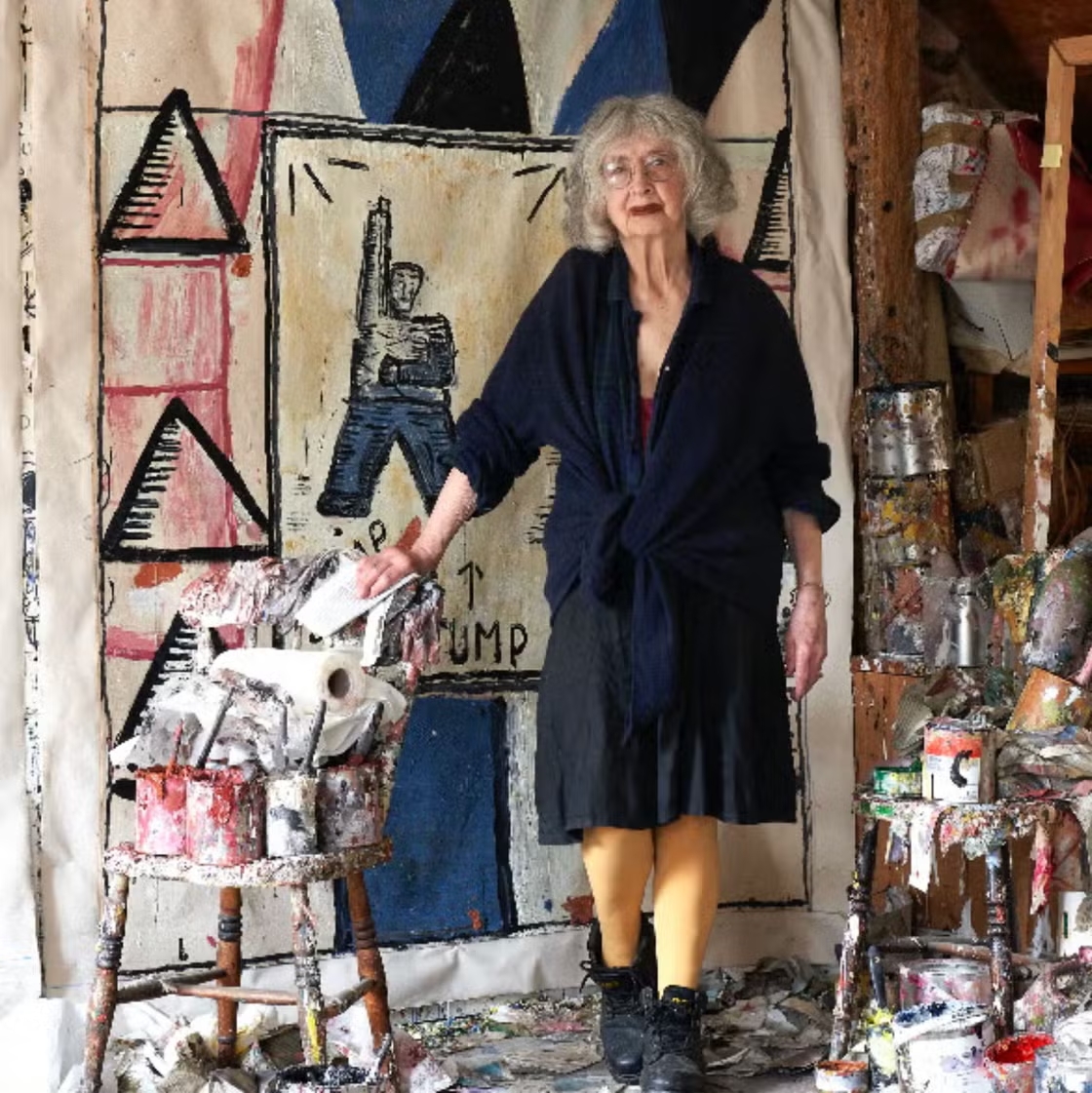
Rose Wylie: The 91-Year-Old British Painter Who Started Late and Took Over the Royal Academy
Rose Wylie is one of those rare artists who proves the timeline of an art career is whatever you want it to be. The British painter, now 91, only began receiving serious critical attention in her late 60s — and by 2026, she had become the first British female artist to fill all the main galleries of the Royal Academy of Arts in London with a single show. Her canvases are huge, gloriously messy, full of footballers, film stars, queens and animals. They look childlike at first glance and reveal themselves as anything but on the second.
If you’re new to her work, or just trying to figure out why everyone from David Zwirner to the Royal Academy is suddenly clamouring to show her, here’s the picture that actually explains it.
Who Is Rose Wylie: Life, Age and the Long Road to Recognition
Rose Wylie was born in Hythe, Kent, on 14 October 1934. That makes her 91 — and she’s still painting, often until 3am, in the same Kent cottage she’s lived in since 1969.
Her path through art was anything but linear. She studied at the Folkestone and Dover School of Art from 1952 to 1956, then stopped painting to raise three children with her husband, the painter Roy Oxlade. The pause lasted decades. She returned to formal study at the Royal College of Art in London and graduated with an MA in 1981 — at age 46.
Even after that, recognition didn’t come quickly:
| Year | Milestone |
|---|---|
| 1981 | Graduates from the Royal College of Art with an MA |
| 2010 | Selected for Women to Watch at the National Museum of Women in the Arts, Washington D.C. |
| 2011 | Wins the Paul Hamlyn Award for Visual Arts |
| 2012 | First retrospective at the Jerwood Gallery, Hastings |
| 2013 | BP Spotlight exhibition at Tate Britain |
| 2014 | Wins the John Moores Painting Prize; elected Senior Royal Academician |
| 2017 | Signs with David Zwirner |
| 2018 | Awarded an OBE in the Queen’s Birthday Honours |
| 2026 | The Picture Comes First fills the Royal Academy main galleries |
The phrase “rebel artist” gets used about her a lot, and it isn’t marketing fluff. She paints alone, mostly at night, on unprimed unstretched canvas spread on the floor. She doesn’t sketch first. She paints from memory.
The Distinctive Style of Rose Wylie’s Art
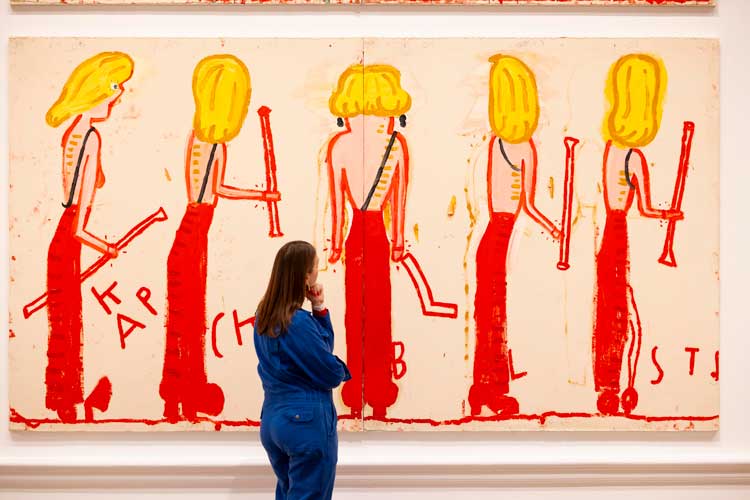
Rose Wylie art is instantly recognisable, even if you’re seeing it for the first time. Big, raw canvas. Bold flat colour. Figures that look like they’ve been drawn fast — though that “fast” hides decades of formal training and decisions you don’t immediately see.
A few things that define her work:
- Scale. Many paintings are over two metres wide; some, like Lords and Ladies (2006) at the National Museum of Women in the Arts, stretch beyond three metres.
- Unprimed, unstretched canvas. No traditional preparation. The fabric’s texture stays part of the finished work.
- Imagery sourced from memory. Films, football matches, news photos, comics, Christmas cards, things glimpsed on the street.
- Words, scribbles and handwriting. Often part of the composition, sometimes barely legible.
- Visible corrections. She paints over, collages over, leaves the previous attempt showing.
- Recurring cast. Elizabeth I, Marilyn Monroe, Nicole Kidman, Serena Williams, Snow White, footballers, bears, birds.
What looks naive is calculated. References to Dürer and Cézanne sit inside what people first dismiss as childlike. As she’s pointed out herself, that’s the part that makes some viewers uncomfortable — once they realise the apparent simplicity is doing real formal work, the painting stops being easy to write off.
She paints “from memory,” not from life. She watches a film, sees a photograph, holds the image in her head, and weeks or months later it shows up on canvas — distorted, simplified, recombined with something else entirely. She calls this her “personal-visual-diary-making.”
Inside Rose Wylie’s Studio in Kent
Rose Wylie’s studio isn’t in a converted warehouse or a glossy purpose-built space. It’s a small cottage in Newnham, near Faversham in Kent, that she’s lived in since 1969. The kitchen has an old-fashioned stove. The doorways are low. Visitors who are tall have to duck.
The cottage and the studio are essentially the same building. Paint spatters everywhere. Canvases on the floor because they’re too big to fit on a wall. A second, smaller studio upstairs in what was likely once a bedroom, the floor strewn with newspapers — some dating back to 2007.
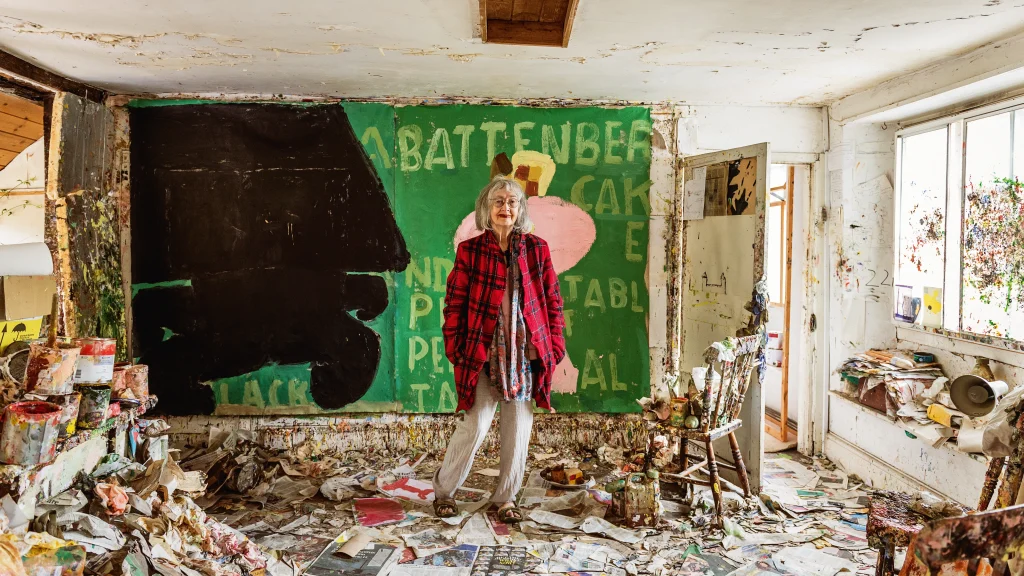
What’s striking, given her current standing, is how unchanged the place is. She’s represented by David Zwirner. Her work is in Tate, the Hammer Museum, Museum Ludwig in Cologne, the Royal Academy. And she still lives and works in the same modest cottage where she raised her children. The art world now comes to her — taxi drivers in Faversham reportedly recognise her visitors on sight.
She works late, often into the small hours. Alone. The cottage was also home to her husband Roy Oxlade until his death in 2016 — a moment that, by coincidence, lined up almost exactly with the takeoff of her own career.
Major Exhibitions and Notable Shows
The list of Rose Wylie shows is now genuinely long. The headline ones are worth knowing if you want to follow her work or trace its evolution.
Recent and significant exhibitions:
- 2026 — The Picture Comes First, Royal Academy of Arts, London (28 February – 19 April 2026). The biggest exhibition of her work to date. First British female artist to occupy all the main galleries.
- 2025 — When Found becomes Given, David Zwirner, London
- 2025 — Henri, Egypt…Bette, Bear, David Zwirner, Paris
- 2022 — picky people notice…, S.M.A.K., Ghent
- 2022 — Cars and Girls, David Zwirner, London
- 2021 — Solo exhibition at Museum Langmatt, Baden, Switzerland
- 2020 — where i am and was, Aspen Art Museum, Colorado (her first solo museum show in the US)
- 2020–2021 — Hullo Hullo Following-on, Hangaram Art Museum, Seoul, then Aram Nuri Arts Center, Goyang
- 2016 — Pink Girls, Yellow Curls, Städtische Galerie, Wolfsburg
- 2013 — Big Boys Sit in the Front, Jerwood Gallery, Hastings
- 2013 — BP Spotlight, Tate Britain
Her work sits in major public collections including Tate, the Royal Academy, the Hammer Museum (Los Angeles), the High Museum of Art (Atlanta), Museum Ludwig (Cologne), S.M.A.K. (Ghent), Zentrum Paul Klee (Bern), the National Museum of Women in the Arts (Washington D.C.), and Arario Museum (Seoul).
Rose Wylie in Print: Books, Catalogues and Critical Writing
For anyone who wants to go deeper, Rose Wylie books and exhibition catalogues are the best entry point after seeing the paintings themselves.
Worth tracking down:
- Exhibition catalogues from major shows — particularly the Royal Academy The Picture Comes First catalogue, the S.M.A.K. picky people notice… publication, and the Aspen Art Museum’s where i am and was book. These usually include critical essays alongside high-quality reproductions.
- Lund Humphries monograph — a planned monograph on her painting, contextualised by Tate curator Clarrie Wallis, has been in the works as part of their contemporary painters series.
- Critical writing in the press — Germaine Greer wrote one of the early major profiles in The Guardian in 2010; subsequent pieces in The Guardian, Frieze, The Art Newspaper and Plaster Magazine have followed her trajectory closely.
- David Zwirner’s Dialogues series — includes a recorded conversation between Wylie and actor Russell Tovey on character, mistakes and painting from film. Useful if you’d rather hear her talk than read about her.
The catalogues matter more than usual with Wylie because her paintings reproduce surprisingly well — the rawness, the handwriting, the patches of unprimed canvas all translate to print. They’re the closest most people will get to her work without travelling to a major museum.
There’s something quietly radical about a painter who spent forty years parenting and waiting, then walked into her seventies with a fully formed body of work nobody had seen yet. Wylie didn’t reinvent painting. She just refused to stop, refused to make her canvases tidier, and refused to retire when most of her peers had long since slowed down.
The Royal Academy taking over for her in 2026 isn’t a late-career farewell. By her own account, she’s still painting at 3am — and she’s been clear that the recognition matters less than the work continuing. For anyone who’s ever felt they started something too late, Rose Wylie is the most useful artist alive.
Frequently Asked Questions
Rose Wylie is famous for her large-scale, deceptively childlike paintings on unprimed canvas, drawing imagery from films, sport, royalty and pop culture. Her fame grew sharply in her 70s after winning the Paul Hamlyn Award (2011) and the John Moores Painting Prize (2014), being elected a Royal Academician in 2014, signing with David Zwirner in 2017, and receiving an OBE in 2018. In 2026 she became the first British female artist to fill all the main galleries of the Royal Academy with a solo show.
Rose Wylie’s paintings are sold primarily through David Zwirner and other major galleries rather than at public auction, so prices aren’t always listed openly. Smaller works on paper and limited-edition lithographs typically range from a few thousand to low five-figure sums in pounds, while large-scale oil paintings on canvas reach well into six figures. For accurate current pricing, contacting David Zwirner or galleries like JARILAGER and Baldwin Contemporary directly is the only reliable answer.
Rose Wylie lives and works in Kent, England, in a small cottage in the village of Newnham near Faversham. She has lived in the same cottage since 1969 and continues to paint there, often working alone late into the night.