Harland Miller: The Painter Who Turned Book Covers Into Modern Masterpieces
Few contemporary artists manage to make you laugh and ache at the same time. Harland Miller does exactly that. Working at the crossroads of painting and literature, he has built a body of work that feels instantly familiar yet deeply unsettling — a strange comfort wrapped in a wry British smile. If you have ever stopped at a gallery wall to read a fake Penguin paperback cover that somehow says everything about modern loneliness, you already know his name.
This article walks through his life, his books, his paintings, his prints, and the market that has turned him into one of Britain’s most collected living artists. By the end, you will understand why a painted book cover can sell for hundreds of thousands of pounds — and why people queue around the block to see one in person.
Who Is Harland Miller: The Artist’s Biography
Born in 1964 in Yorkshire, Harland Miller belongs to a generation of British artists who came of age in the shadow of the YBAs but carved out something quieter and more literary. He is a painter who writes, and a writer who paints — and refusing to choose between the two has shaped everything he does.
His career is unusual in that it ran on two tracks for years. While his peers were chasing the spotlight in 1990s London, Miller was bouncing between cities, finishing a novel, and slowly developing the visual language that would later define him. The result is an artist whose canvases read like short stories and whose sentences land like brushstrokes.
Childhood and Youth in Harland Miller’s York
Yorkshire shaped him before art school did. Growing up in York, Miller absorbed the grey skies, the stubborn humour, and the working-class wit that still soak into his paintings today. The melancholy in his work is not a pose — it is a regional dialect.
He has spoken in interviews about the importance of secondhand bookshops in his youth, where he flipped through battered Penguin paperbacks and noticed something nobody else seemed to. The covers were art. Tiny, perfect, mass-produced art. That observation would stay with him for decades.
Education and the Path to an Artistic Career
Miller studied at Chelsea School of Art in London, finishing his MA in the late 1980s. After graduating, he refused to settle. He lived in New York, Paris, and Berlin, picking up odd jobs, writing, painting, and absorbing whatever the city had to offer.
That restlessness matters. His work carries the texture of someone who has spent time alone in foreign hotel rooms, watched the rain in unfamiliar streets, and learned to find dark comedy in the gaps between cultures.
Literary Career: Harland Miller Books
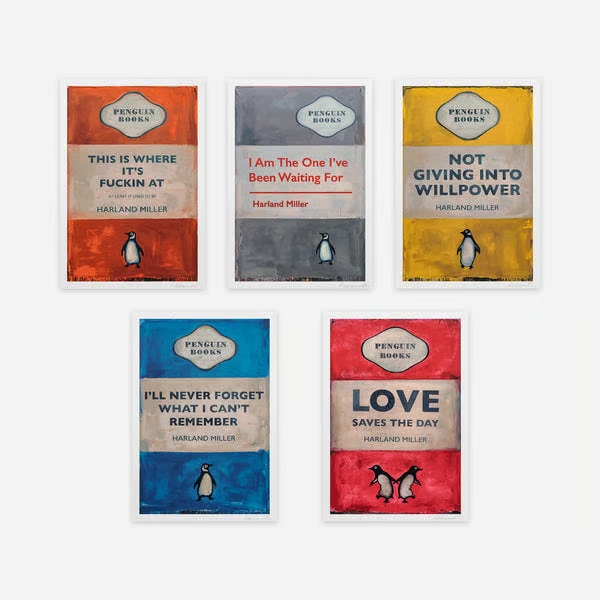
Before most people knew him as a painter, Miller was a novelist. His debut, Slow Down Arthur, Stick to Thirty, was published in 2000 and earned warm reviews for its sharp ear for working-class Yorkshire life and its bittersweet humour. The book follows a teenage boy navigating a world of Bowie obsessives, dodgy father figures, and small-town disappointments.
Reading the novel reframes the paintings. The same voice runs through both. There is the same instinct for a punchline that hides a bruise, the same affection for ordinary people, the same eye for the absurd dignity of British life.
Writing also taught him something that most painters never learn: how to title a work. His painted phrases — “International Lonely Guy”, “Tonight We Make History (P.S. I Can’t Be There)”, “Death, What’s In It For Me?” — work because they were built by someone who knows exactly how a sentence breathes.
The Iconic Penguin Book Cover Series
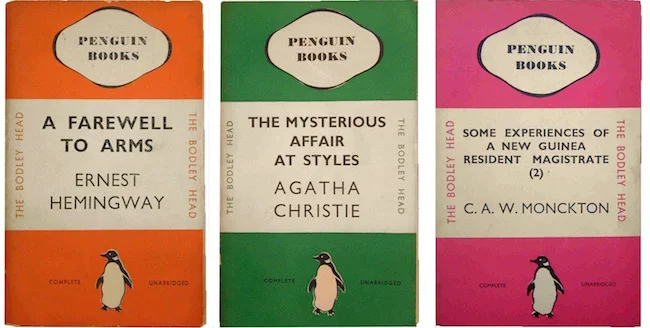
Ask anyone to picture a Harland Miller painting and they will describe the same thing: a giant, weathered Penguin paperback cover, slightly battered, with a title that reads like a joke a sad person would tell. This series put him on the map and made him a household name in collecting circles.
The genius is in the contradiction. Penguin covers were designed for mass consumption — cheap paper, pocket-sized, instantly recognisable. Miller blows them up to enormous scale and treats them with the gravity of history paintings. A throwaway object becomes monumental.
How the Harland Miller Penguin Series Came to Life
The series started in the early 2000s, partly as a private joke that grew teeth. Miller began painting fake Penguin covers with invented titles, dressing existential dread in the cheerful orange livery of postwar British publishing.
Early works mimicked the design templates faithfully — the tri-band layout, the small author credit, the centred title block. Then he began to age them. Coffee stains. Foxing. Bent corners. The covers looked like they had survived something. So did the punchlines.
Text as the Heart of the Visual Statement
The text on a Miller painting is never decoration. It is the work. He treats typography the way other painters treat a face — every letter weighted, every space deliberate.
The phrases swing between three registers, often inside a single canvas:
- Deadpan humour — “I’m So Fucking Hard”
- Quiet despair — “Back On The Worry Beads”
- Absurd philosophy — “Hate’s Outta Date”
What looks like a one-liner is usually doing three things at once. A laugh. A confession. A small protest against being alive on a Tuesday.
Painting Style and Technique: Harland Miller Paintings
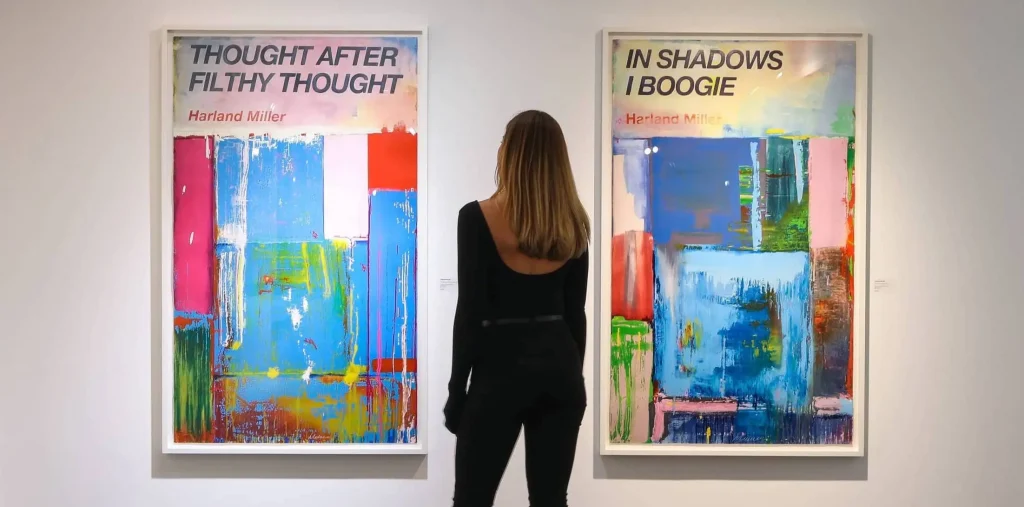
Up close, Miller’s paintings reveal what reproductions hide. The surfaces are rich, layered, scratched, stained, and built up with real painterly muscle. He uses oil and acrylic, often working over photographic underpaintings, scuffing edges, and forcing the canvas to look older than it is.
The colour fields — those flat blocks of orange, blue, green, or pink — are deceptively complex. They glow because of what is underneath them. There is dirt in the light. That is the whole trick, and it is a hard one.
His method blends commercial art techniques with traditional painting. He references printing, advertising, and graphic design without imitating them. The work knows where it came from.
Key Series and Recognisable Imagery
Miller’s catalogue is broader than the Penguin covers, even if those remain the most reproduced. The other major bodies of work include:
| Series | Visual Reference | Mood |
|---|---|---|
| Penguin Paperback Paintings | Penguin Modern Classics | Sardonic, literary |
| Pelican Bad Weather Paintings | Pelican non-fiction covers | Brooding, atmospheric |
| International Lonely Guy | Pulp magazine layouts | Wry, isolated |
| Letter Paintings | Single bold letterforms | Graphic, punchy |
| Death, What’s In It For Me? | Self-help and pulp hybrids | Gallows humour |
The Letter Paintings, in particular, mark a shift. Stripped of book-cover scaffolding, a single letter — Y, L, F — fills the canvas, and Miller uses it like an abstract painter would. The text is still there. It just refuses to behave.
Editions and Printmaking: Harland Miller Prints
Original Miller paintings sit out of reach for most people. His prints do not. This is where the work meets a wider audience, and Miller has taken printmaking seriously enough that the editions are coveted in their own right.
He works mainly in screenprint and etching, often with embossing, gold leaf, or hand-finished elements that push prints closer to objects. Editions are typically released through:
- White Cube — his primary gallery representation
- Other Criteria — the publishing house co-founded by Damien Hirst, which produced many of Miller’s most iconic editions
- Various charitable and museum collaborations
For collectors getting started, prints are the natural entry point. They preserve the texture, the colour, and the deadpan title — the three things that matter most.
Exhibitions and Recognition
Miller’s work has been shown at White Cube in London, Hong Kong, and New York, alongside museum exhibitions across the UK and Europe. His 2017 show at the Baltic Centre for Contemporary Art in Gateshead, Tonight We Make History (P.S. I Can’t Be There), was a turning point — his largest institutional outing and a critical success.
Critics have placed him in the lineage of Ed Ruscha and Richard Prince, artists who treat language as image. The comparison is fair. The difference is that Miller writes like a novelist, not a slogan-maker, and that gives his work a depth that pure text-art often lacks.
His paintings sit in private collections around the world and in the holdings of major institutions, including the Walker Art Gallery in Liverpool and the Government Art Collection.
Market Value: Harland Miller Prices
Miller’s market has climbed steeply since the mid-2010s, and the pace shows no obvious signs of slowing. His paintings now regularly hit six- and seven-figure sums at auction, with several major works crossing the £1 million mark.
A rough sense of the market today:
| Format | Typical Range |
|---|---|
| Open-edition smaller prints | £500 – £3,000 |
| Limited-edition signed screenprints | £3,000 – £30,000 |
| Rare or sold-out prints (secondary market) | £15,000 – £80,000+ |
| Mid-size paintings | £150,000 – £500,000 |
| Major paintings at auction | £500,000 – £1.5 million+ |
Several factors drive value:
- Series desirability — Penguin paintings command premiums over later experiments
- Edition size — smaller editions appreciate faster
- Condition — print collectors care deeply about margins and surface
- Provenance — works from notable collections fetch more
- Title appeal — yes, really; the wittiest titles sell hardest
If you are buying, work with established galleries or reputable secondary-market dealers. The Miller market has attracted enough heat that fakes and unauthorised reproductions occasionally surface.
The Artist’s Personal Life
Miller is famously private. He lives between London and New York, keeps a low public profile, and shares little about his family in interviews. He has a son, and details about a Harland Miller wife or long-term partner are not something he has put into the public record.
That privacy is part of the work. The melancholy in his paintings reads as authentic precisely because it is not being performed for an audience. He paints loneliness like someone who has thought about it for a long time, on his own, in good light.

Harland Miller occupies a rare spot in contemporary art. He is funny without being shallow, literary without being precious, and commercially successful without losing the bruised honesty that made the work matter in the first place. The fusion of word and image he has built is genuinely his — nobody else paints quite like this, and nobody else writes quite like this on canvas.
The trajectory points upward. New series keep arriving, the prints keep selling out, and a new generation of collectors is discovering that a painted book cover can hold an entire emotional life. If you have not seen one in person yet, find a way to. The reproductions miss the half of it that lives in the surface.
Frequently Asked Questions
Harland Miller is a British artist and novelist, born in Yorkshire in 1964. He is best known for large-scale paintings that reimagine vintage Penguin and Pelican book covers with invented, often darkly funny titles. He is also the author of the novel Slow Down Arthur, Stick to Thirty.
His most recognised works come from the Penguin paperback series, with paintings like International Lonely Guy, Death, What’s In It For Me?, and Tonight We Make History (P.S. I Can’t Be There) among the most celebrated. The Penguin series as a whole is what made him a household name in contemporary art.
Miller divides his time between London and New York, and has spent significant periods working in Paris and Berlin. He keeps his personal life private and rarely discusses specific addresses or routines in public.
Prices range widely. Signed limited-edition prints typically sell from around £3,000 to £30,000, while major paintings have sold at auction for over £1 million. Smaller open-edition prints can occasionally be found for under £3,000, and rare sold-out editions trade strongly on the secondary market.