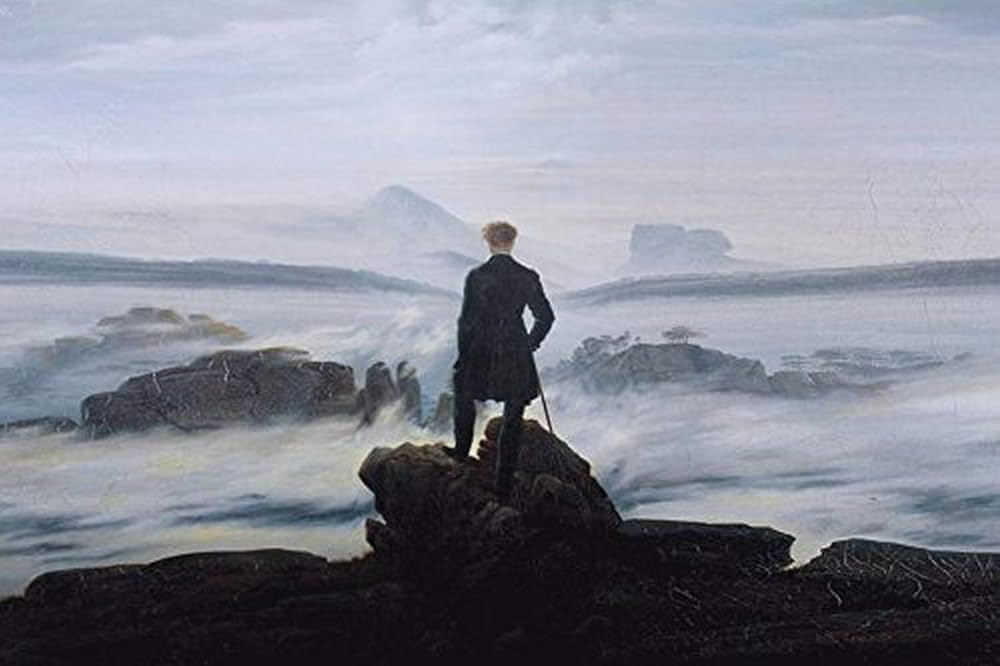
Wanderer above the Sea of Fog: The Painting That Refuses to Stay in 1818
If you’ve ever scrolled through Tumblr, opened a philosophy textbook, or watched the opening credits of Severance, you’ve probably seen Wanderer above the Sea of Fog without knowing its name. A man in a green coat, back turned, standing on a jagged rock above an ocean of mist. It’s been called the most recognizable painting of German Romanticism — and arguably the internet’s favorite oil painting of the last decade.
But the image is far stranger than the memes suggest. Painted by Caspar David Friedrich more than two centuries ago, it asks a question we still haven’t answered: what does it mean to stand alone in front of something vast?
The Story Behind Caspar David Friedrich’s Iconic Painting
Caspar David Friedrich was 44 years old when he completed this work in 1818. He’d just married Caroline Bommer earlier that year, and his style had matured into the moody, spiritually charged landscapes he’s now famous for.
The painting almost certainly grew out of his hiking trips through the Elbe Sandstone Mountains in Saxony — a region he wandered for years, sketching rock formations that would later appear in his canvases. Several of the peaks visible in the background can still be identified today: the Zirkelstein, the Rosenberg, and the Kaiserkrone, among others.
Friedrich worked slowly, building up landscapes from individual sketches drawn on location. The wanderer himself was added later in the studio. This wasn’t a snapshot of a real moment — it was a constructed scene, stitched together from real geography and pure imagination.
A few key facts worth knowing:
- Year completed: 1818
- Medium: Oil on canvas
- Dimensions: 94.8 × 74.8 cm (smaller than most people imagine)
- Original title in German: Der Wanderer über dem Nebelmeer
- Current home: Hamburger Kunsthalle, Germany
For most of the 19th and early 20th centuries, Friedrich was actually forgotten. His revival came through the Symbolists and later the Surrealists, who recognized something deeply modern in his work.
Composition and Visual Elements: What’s Actually in the Frame
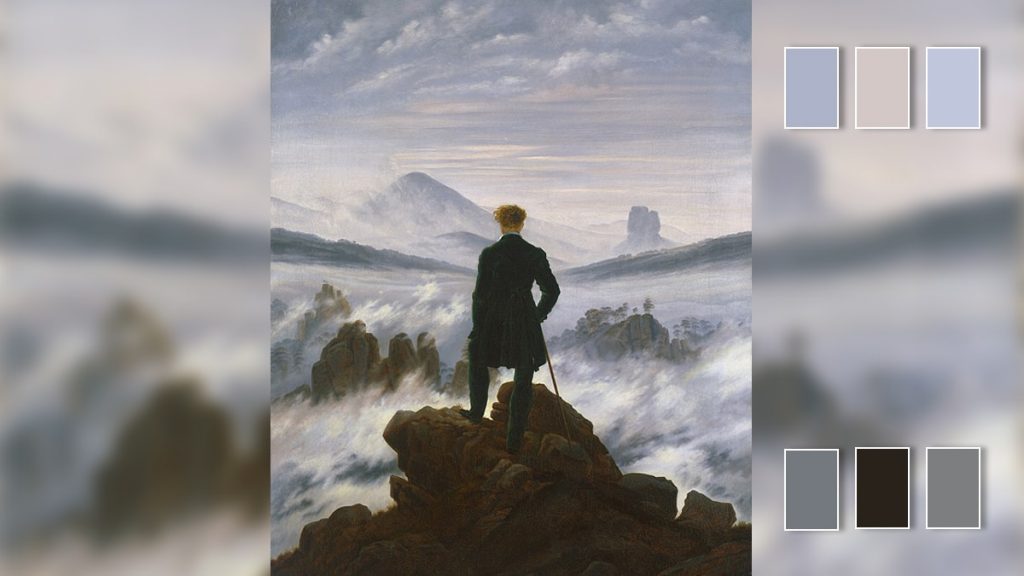
Spend a minute really looking at the wanderer above the sea of fog painting and the staging becomes obvious — Friedrich built it like a stage set. The figure stands almost dead center, slightly elevated, with the entire composition radiating outward from his body.
What you see, layer by layer:
| Element | Position | Function |
|---|---|---|
| The wanderer | Foreground center | Anchor point, viewer’s stand-in |
| Dark rocky outcrop | Lower third | Solid ground, “the known” |
| Sea of fog | Middle ground | The unknown, the obscured |
| Mountain peaks | Background | Distant aspirations or threats |
| Pale sky | Upper third | Vastness, infinity |
The figure’s pose is deliberate. Right foot forward, walking stick in hand, head tilted slightly upward. He’s not posing for a photo — he’s actively looking. Friedrich gives us the viewer’s perspective by turning the man’s back toward us, a technique called Rückenfigur that became a signature of his work.
Color-wise, the painting is restrained. Cool grays, muted greens, a few touches of warmer tone in the rocks. The mist isn’t just atmospheric — it’s structural, dividing the canvas into bands that pull the eye from foot to horizon.
Wanderer above the Sea of Fog Meaning: Romanticism, Solitude, and the Sublime
Ask ten art historians what the painting means and you’ll get ten overlapping answers. That ambiguity is the point.
The most accepted reading places the work squarely within the German Romantic tradition. Romanticism prized emotion over reason, nature over civilization, and the individual soul confronting forces larger than itself. Friedrich’s wanderer embodies all three.
The concept of the sublime — articulated by Edmund Burke and Immanuel Kant in the late 18th century — sits at the heart of the image. The sublime is what happens when beauty becomes overwhelming, when nature stops being pretty and starts being terrifying in its scale. The wanderer is experiencing exactly that. He’s not enjoying the view; he’s confronting it.
Common interpretive layers:
- Spiritual contemplation. Friedrich was deeply religious, and many scholars read the fog as a metaphor for divine mystery — what we cannot see but must trust exists.
- The individual against the world. The lone figure against the vast landscape became a defining image of Romantic individualism.
- Mortality and the unknown future. The sea of fog hides what lies ahead, much as life obscures its own ending.
- Memorial reading. Some scholars argue the painting commemorates a fallen soldier from the Napoleonic Wars, given the green uniform-like coat.
What makes the meaning so durable is that it works on every level simultaneously. You can read it as theology, as politics, as personal grief, or as a hiker enjoying a particularly good morning. Friedrich left enough space for all of it.
Who Is the Figure? Theories About the Man on the Rock
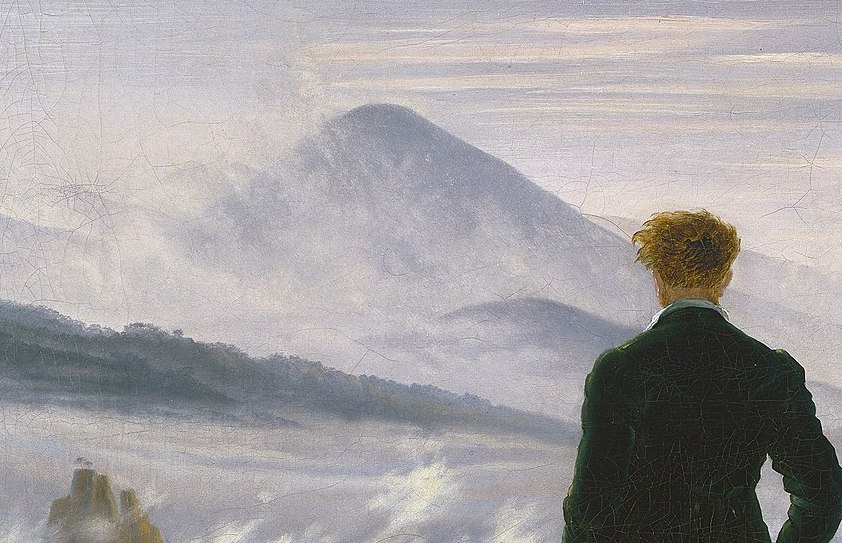
This is where things get genuinely contested. Friedrich never identified the figure, and he didn’t write extensively about his own work. So the man in the green coat has become a kind of art-historical Rorschach test.
The main theories:
- A self-portrait. The reddish-blonde hair matches Friedrich’s own coloring. Some art historians, including the influential Helmut Börsch-Supan, have argued the wanderer is the artist himself.
- A memorial to Colonel Friedrich Gotthard von Brincken. A high-ranking Saxon infantry officer who died in 1813 or 1814. The green coat resembles a Saxon officer’s uniform, and Friedrich painted several memorial works in this period.
- An everyman figure. Many scholars argue the man is intentionally anonymous — meant to be inhabited by the viewer, a vessel rather than a portrait.
- A pure compositional device. A more practical reading: Friedrich needed a focal point to give the landscape human scale, and the figure serves that role first and foremost.
The truth is probably layered. Friedrich often combined the personal, the political, and the symbolic in a single image. The wanderer doesn’t have to be just one thing.
The Painting’s Journey: From 1818 to the Hamburger Kunsthalle
For a piece now considered one of the greatest paintings of the 19th century, Wanderer above the Sea of Fog had a surprisingly quiet first hundred years. It was likely commissioned or purchased by an early patron, then passed through private hands for generations.
The painting only entered the Hamburger Kunsthalle’s collection in 1970, when the museum acquired it. Since then it has become the institution’s most recognizable holding — the painting people specifically come to Hamburg to see.
It’s left the museum only rarely. Major Friedrich retrospectives in 2024 (marking the 250th anniversary of his birth) brought it to Berlin and other venues, drawing record crowds. In 2025, exhibitions in New York extended that wave of attention internationally.
If you want to see it in person:
- Where: Hamburger Kunsthalle, Glockengießerwall 5, Hamburg
- Best time: Weekday mornings — the painting is small and the room gets crowded
- What to know: The label is sparse. Most of what makes the work powerful happens when you stand close enough to see the brushwork on the rocks
A practical tip from anyone who’s been: don’t rush to it first. Walk through the rest of the Friedrich collection, get used to his visual language, then come back. The painting reads completely differently after you’ve seen Monk by the Sea or The Sea of Ice.
How Much Is Wanderer above the Sea of Fog Worth Today
Short answer: nobody knows, because it’s never been to auction.
The painting belongs to the Hamburger Kunsthalle, a public institution. Like most masterpieces in major European museums, it’s effectively priceless in the sense that it’s not for sale and never will be. Estimates from art-market commentators sometimes float numbers in the hundreds of millions of euros, but these are speculation, not appraisals.
For context on what a Friedrich-level painting could theoretically command, consider the wider market for German Romantic art:
- Friedrich works rarely come to market. When they do, they’re usually smaller pieces or studies.
- A previously unrecognized Friedrich, Karkonosze Landscape with Rising Fog, sold at Sotheby’s in 2023 for over £2 million — many times its low estimate.
- Comparable 19th-century landscape masterpieces by Turner or Constable in private hands have been valued well into the eight-figure range.
If Wanderer above the Sea of Fog ever entered the market — which it won’t — it would almost certainly break records for German Romantic painting. But its real value lies in being seen, not sold.
Cultural Footprint: Book Covers, Memes, and the Severance Connection
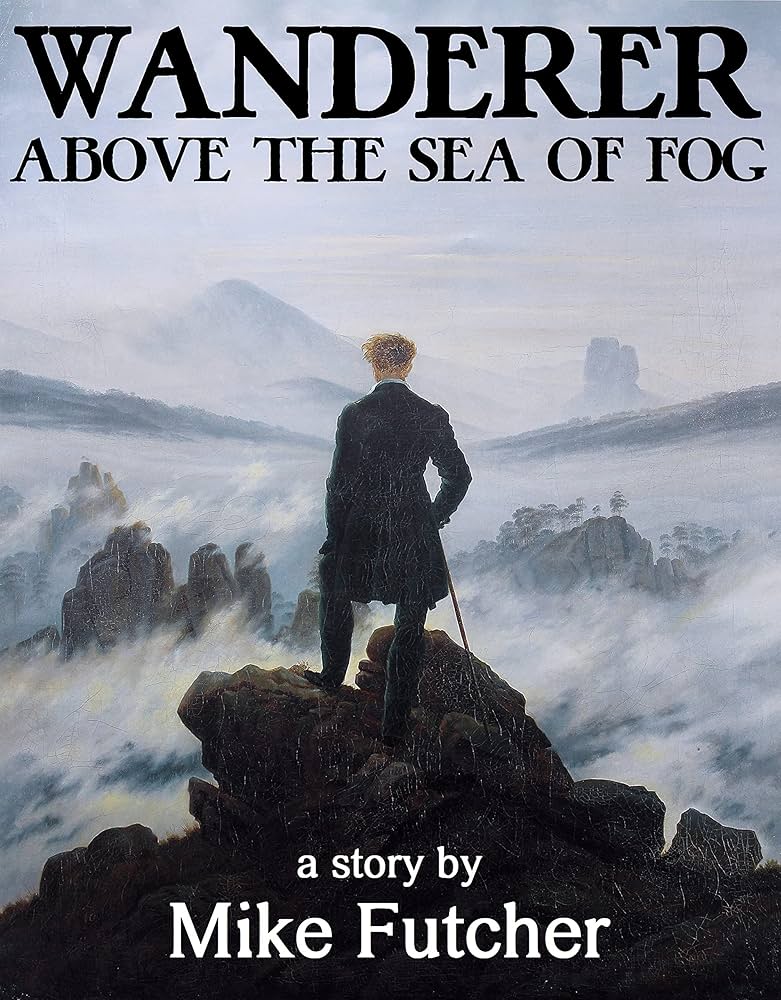
This is where the painting truly leaves the museum. Few artworks have had a richer second life on the internet and in pop culture.
The image has appeared on the cover of dozens of books — most famously on editions of philosophy texts (Nietzsche, Schopenhauer, the Romantics) and contemporary novels exploring isolation, ambition, or self-discovery. It’s become visual shorthand for “deep thinking” so reliably that publishers reach for it almost reflexively.
The Severance connection is more recent. The Apple TV+ series uses Friedrich’s aesthetic — and in its second season, direct visual quotations of the wanderer — to underscore themes of fractured identity, hidden inner worlds, and the unknown self standing at the edge of something it can’t quite see. The pairing works because Friedrich and the show are asking the same question in different languages.
Other notable appearances:
- Memes. The figure’s back-turned pose makes him perfect for caption manipulation. Replace the fog with anything — a deadline, a queue at the DMV, a childhood trauma — and the joke writes itself.
- Minecraft recreations. Players have built blocky tributes to the painting, with one figure standing on a pixelated cliff over a sea of generated mist. It’s become a small genre of its own among art-leaning Minecraft builders.
- Music videos and film references. Multiple directors have framed shots in deliberate echo of the composition.
- Book design. From philosophy paperbacks to contemporary fiction with titles like Wanderer Above the Sea of Fog used as homage, the image has become a publishing-industry workhorse.
What’s striking is how well the painting survives all this. It gets memed, parodied, reproduced on phone cases, and reframed in TV credits — and it still hits hard when you stand in front of the original. Few images can take that kind of cultural beating without losing their power.
Two centuries on, the figure on the rock is still up there. Friedrich painted a single moment of contemplation and accidentally captured something we keep returning to — the feeling of standing at the edge of something we don’t fully understand, and choosing to look anyway. The painting works because it doesn’t tell you what the wanderer is thinking. It hands you the silence and lets you fill it in.
That’s also why every generation finds it new. The fog rolls in, the rocks stay solid, the man keeps his back turned — and somehow we keep recognizing ourselves in him.
Frequently Asked Questions
The painting symbolizes the Romantic confrontation between the individual and the sublime — the overwhelming vastness of nature, the unknown future, and the human soul’s place within it. It’s commonly read as a meditation on solitude, spiritual contemplation, and self-reflection, with the sea of fog representing what we cannot see or know. Friedrich left the meaning intentionally open, which is why it works equally as a religious image, a memorial, or a personal allegory.
There’s no official answer, but several works are frequently named in this conversation: Pablo Picasso’s The Old Guitarist (1903–1904), Edvard Munch’s The Sick Child, and Vincent van Gogh’s Sorrowing Old Man (At Eternity’s Gate). Caspar David Friedrich’s Monk by the Sea — a companion piece in spirit to Wanderer above the Sea of Fog — is also regularly cited for its overwhelming sense of isolation.
Many famous paintings have crossed that threshold over the years. Notable examples sold at or near $70 million include Vincent van Gogh’s Portrait of Dr. Gachet (sold for $82.5 million in 1990), Pablo Picasso’s Yo, Picasso (around $47.8 million in 1989, equivalent to over $70 million adjusted for inflation), and several Mark Rothko works that have crossed this mark in private sales. The art market sees works at this price level regularly at major auctions, particularly for Impressionist, modern, and contemporary masterpieces.