The Empire of Light: Inside Magritte’s Most Haunting Optical Illusion
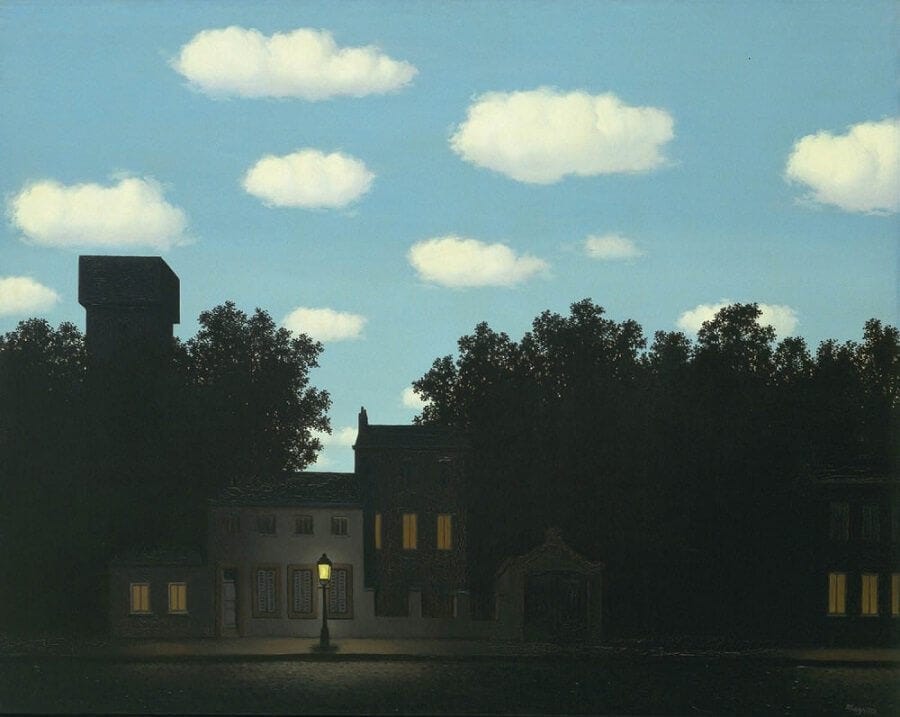
Stand in front of The Empire of Light for the first time and something strange happens. Your eyes register a peaceful daytime sky — soft blue, gentle clouds drifting across it. A second later, you notice the street below is sunk in deep night, with a single lamppost glowing against a dark house. You look up again. The sky has not changed. The contradiction has not resolved. That quiet, persistent wrongness is exactly what René Magritte wanted you to feel.
This article walks through the story of the painting, what it means, how Magritte built the illusion, where you can see the surviving versions today, and why it remains one of the most reproduced and reinterpreted images of the twentieth century.
What Is The Empire of Light: A Surrealist Icon
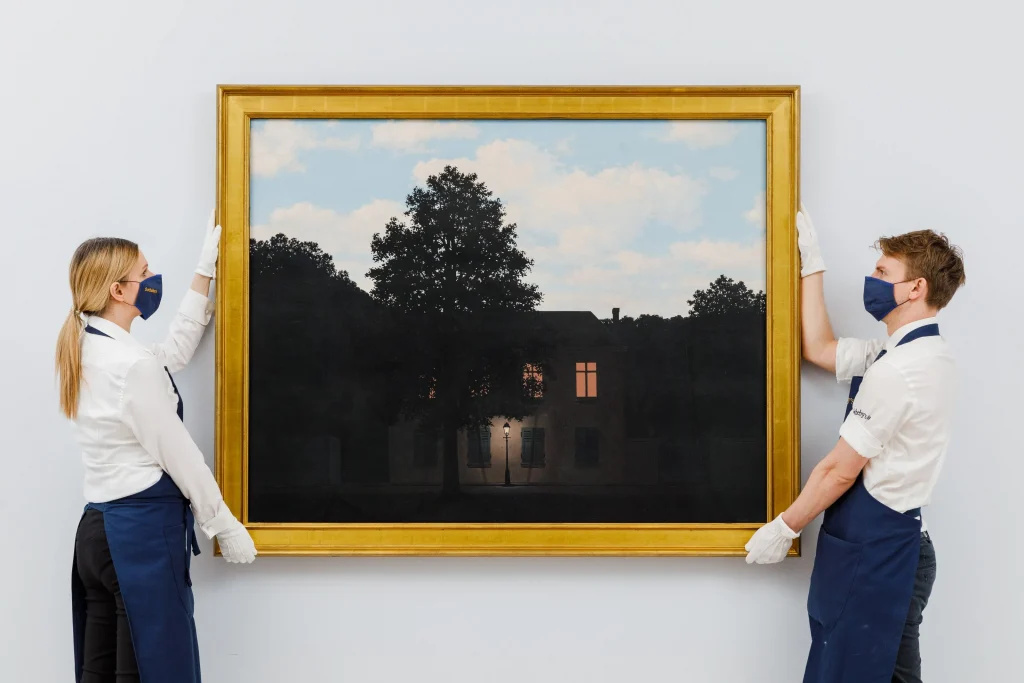
The Empire of Light — L’Empire des Lumières in the original French — is a series of paintings by the Belgian surrealist René Magritte, begun in 1949 and continued until his death in 1967. Each version shows the same uncanny scene: a tranquil daytime sky hovering above a nocturnal street.
It belongs to that small club of paintings that almost everyone recognises, even people who could not name a single Magritte work. The image has the calm authority of a postcard and the unease of a half-remembered dream. That tension is why it endures.
The Visual Paradox: Day and Night in One Frame
The composition is deceptively simple. A modest house sits behind tall trees. A streetlamp burns. A window or two glows yellow. A pond or wet street reflects the lamplight back. Above all of this stretches a sky that belongs to a different hour entirely — bright, blue, full of cumulus clouds.
Nothing in the painting is surreal on its own. The trees are just trees. The lamppost is a lamppost. The sky is a perfectly painted sky. The surrealism lives in the seam between them. Magritte does not give you a melting clock or a flying fish. He gives you logic, then quietly breaks it.
Empire of Light Magritte Meaning
Magritte himself resisted neat interpretations, but he gave a few clues. He said the painting expressed something he genuinely felt — a love of night and day at once, and a sense that the visible world is stranger than we admit.
The work tends to read on three layers:
- The perceptual layer — your eye fights with what it knows
- The philosophical layer — reality is a construction, not a given
- The emotional layer — peace and dread can occupy the same room
That last layer is the one most people remember. The scene looks safe. It does not feel safe.
The Story Behind the Magritte Empire of Light Series
Magritte rarely repeated himself the way he repeated this image. Between 1949 and 1964 he produced roughly seventeen oil paintings and around ten gouaches under the same title, each one a variation on the same idea. He could not let it go.
Part of the reason was demand — collectors and museums wanted their own. But part of it was Magritte himself returning to the puzzle, adjusting the trees, shifting the lamp, deepening the sky. He treated the image less like a finished work and more like a question he kept asking.
The First Version and Its Origins
The original oil version dates to 1949, painted in postwar Brussels during a period when Magritte’s style had fully settled into the cool, illustrative manner that would define his late career. He had moved past his earlier experiments and arrived at the visual register the world now associates with his name.
The first painting is quieter than the later ones. The contrast between sky and street is gentler. As the series developed, Magritte tightened the screw — darker streets, brighter skies, sharper unease.
Variations Across Two Decades
Each version shifts something. Sometimes it is the angle of the house. Sometimes the number of lit windows. Sometimes the presence or absence of a reflective pond. Hold two versions side by side and the differences become a kind of visual rhyme.
Here is a rough sense of how the major versions distribute across formats and dates:
| Format | Approximate Count | Time Span |
|---|---|---|
| Oil paintings | ~17 | 1949 – 1964 |
| Gouaches on paper | ~10 | 1950s – 1960s |
| Studies and sketches | several | throughout |
The gouaches are smaller and often more intimate. The oils carry the institutional weight. Both are sought after, and both behave like the same idea reaching for slightly different temperatures.
Technique and Composition: The Paradoxical Line in Magritte’s Painting
The illusion works because Magritte was a precise, almost commercial painter. His surfaces are smooth. His edges are clean. There is no expressive brushwork drawing attention to itself. The painting does not look like it is hiding anything — and that is what makes the trick land.
If the sky were stylised or the street were exaggerated, your brain would file the scene under “fantasy” and move on. Magritte refuses that exit. He paints both halves with equal, patient realism. The paradox arrives in the eye, not on the canvas.
Light, Shadow, and Atmosphere
The lamppost is the anchor. Its glow defines the night, casts soft warmth onto the surrounding leaves, and reflects in the water below. Magritte handles the light source with restraint — it is bright enough to read as night, dim enough to feel real.
The windows of the house do similar work. One or two squares of yellow tell you, without argument, that someone is home and the hour is late. Above all of that, the daytime clouds keep doing their daytime business, indifferent to the rules being broken below them.
Symbols Hidden in Plain Sight
Magritte’s vocabulary is small and consistent. The same elements show up across his work, and The Empire of Light gathers several of them in one place:
- The bourgeois house — domesticity, safety, a stage for the uncanny
- The bare or silhouetted trees — a screen, almost a curtain
- The lit streetlamp — the only active actor in an otherwise still scene
- The cloud-filled sky — Magritte’s signature, used like a signature
- The reflective water — a doubling device, a second world below the first
None of these are obscure symbols. That is the point. Magritte builds his strangeness out of furniture you already own.
Where the Empire of Light Paintings Live Today
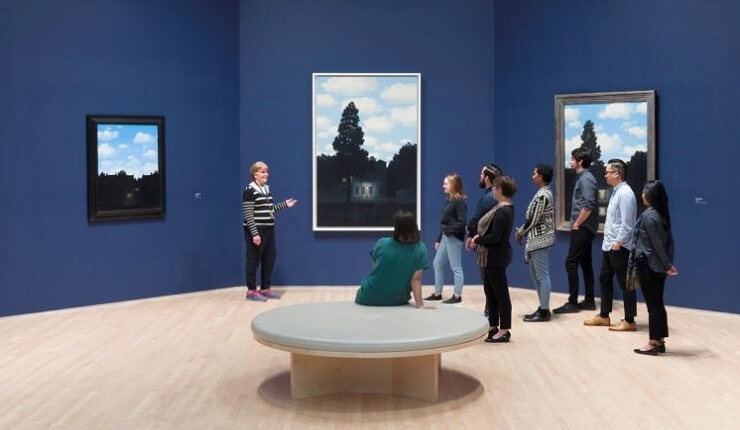
Because Magritte made so many versions, the series is unusually well-distributed. You do not have to travel to one specific city to see one in person. Several of the most important versions hang in major public collections, and others surface periodically on the auction market.
The Versions in Major Museums
The most accessible places to see an Empire of Light painting today include:
| Museum | City | Version |
|---|---|---|
| Museum of Modern Art (MoMA) | New York | 1953–54 oil |
| Magritte Museum / Royal Museums of Fine Arts of Belgium | Brussels | Multiple works including a major version |
| Peggy Guggenheim Collection | Venice | 1953–54 oil |
| Menil Collection | Houston | Earlier oil version |
| National Gallery of Victoria | Melbourne | 1950s version |
If you are planning a trip around seeing one, the Brussels collection is the richest single stop for Magritte more broadly. Venice gives you the painting in one of the most beautiful museum settings on earth. New York puts it on a wall surrounded by the rest of twentieth-century modernism, which changes how you read it.
Versions in Private Hands
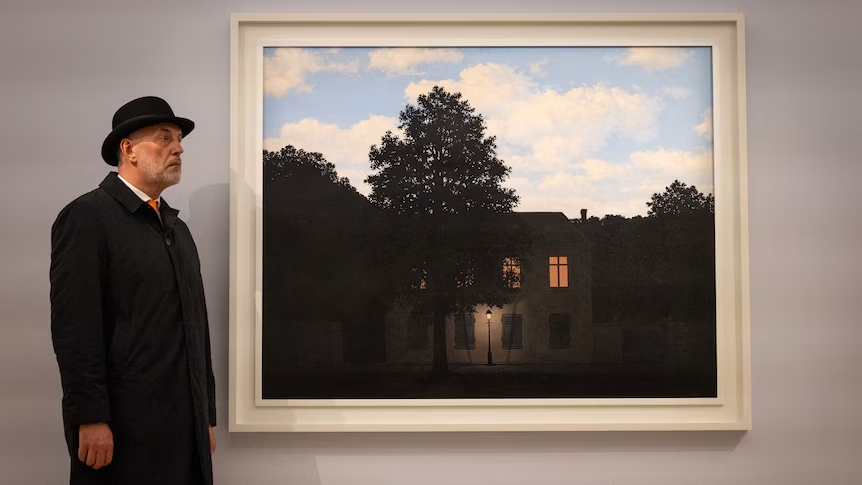
Several oils and gouaches remain in private collections, and a handful have made auction history. The version painted in 1954 sold at Sotheby’s in March 2022 for around £59.4 million, setting a record for the artist. The buyer was not publicly named — typical for sales at this level, where private collectors and foundations bid through advisors.
Earlier sales of other versions have routinely cleared the eight-figure mark. Each appearance at auction tends to redraw the ceiling for Magritte’s market.
Cultural Impact and Legacy
Few twentieth-century paintings have leaked so thoroughly into the wider visual culture. Once you know The Empire of Light, you start spotting its DNA everywhere — in film posters, album covers, book jackets, and the lighting of a hundred quiet street scenes in cinema.
William Friedkin lifted the composition almost directly for the iconic poster of The Exorcist, with the figure of Father Merrin standing beneath a streetlamp in front of a glowing window. That single borrowing put Magritte’s image into the visual memory of millions of people who have never set foot in a museum.
The Empire of Light Book and Literary References
The painting has inspired or lent its title to several literary works. Steven Millhauser’s short story collection The Knife Thrower and various essays on perception cite the image directly. Novels and poems use the scene as shorthand for a particular kind of beautiful, unstable calm.
The 2022 Sam Mendes film Empire of Light, while not a direct adaptation, draws its title and atmospheric mood from a similar emotional register — a quiet melancholy lit from within.
From Gallery Walls to Magritte Empire of Light Posters
The image is one of the best-selling fine art posters in the world. Walk into any decent print shop, museum gift store, or online art retailer and you will find it reproduced in dozens of sizes and finishes.
Why does it work as a poster when so many great paintings do not? A few practical reasons:
- The composition reads cleanly at any size
- The colours are limited and harmonious
- The image holds its mystery even at low resolution
- It looks at home in almost any room
That last point matters. The painting’s calm surface lets it settle into a living space without dominating it, while the paradox keeps it from ever becoming wallpaper.
Why This Painting Still Matters
Surrealism produced more shocking images. It produced more technically virtuosic ones. The Empire of Light has outlived most of them because it does something rarer — it stays calm. The unease is permanent because the painting refuses to dramatise itself.
Contemporary artists working with photography, AI imagery, and digital composition keep returning to the same problem Magritte solved with a brush: how do you make a viewer doubt a picture that looks completely ordinary? His answer still works. That is why this painting feels modern in a way that very little 1949 art does.
The Empire of Light is one of those rare paintings that gets stranger the longer you look. Magritte took two of the most familiar things in any landscape — the sky and the street — and rearranged the hour they belong to. The result is a quiet, lasting puzzle that has held up across seventy-five years of changing tastes.
If you ever get the chance to stand in front of one of the versions in Brussels, New York, Venice, or Houston, take it. The reproductions are good, but the painting itself does something to a room. You walk in, you look up, and for a moment the day and the night are doing the impossible together, exactly the way Magritte wanted.
Frequently Asked Questions
There is no single Empire of Light painting — Magritte created around seventeen oil versions and ten gouaches between 1949 and 1964. The most accessible versions are housed at the Museum of Modern Art (MoMA) in New York, the Magritte Museum in Brussels, the Peggy Guggenheim Collection in Venice, the Menil Collection in Houston, and the National Gallery of Victoria in Melbourne. Several other versions remain in private collections.