Michaël Borremans: The Belgian Painter Who Makes You Uncomfortable
Michael Borremans paints the kind of pictures you can’t shake off. A woman in a dress that swallows her face. A child smeared in red. A man holding an object that shouldn’t exist. His canvases look like they were pulled out of a 17th-century museum — until you notice something is deeply wrong.
Critics compare him to Velázquez and Manet. Collectors pay millions for his work. And his exhibitions regularly trigger heated debate, sometimes outrage. In this article we’ll walk through his biography, dissect his visual language, examine his most discussed series, and look at what his paintings actually cost on the contemporary market.
Biography and Artistic Path
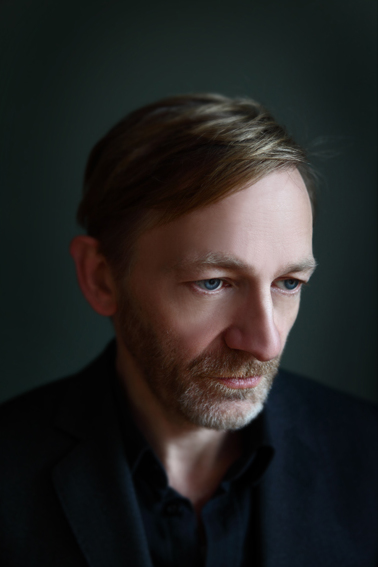
Michaël Borremans was born in 1963 in Geraardsbergen — a small town in the Flemish part of Belgium. His path to painting was anything but direct.
For years he studied photography and printmaking at Sint-Lukas in Ghent. He worked as a teacher, made etchings, took pictures. Painting came late — Borremans only seriously picked up the brush in his mid-thirties.
That delayed start turned out to be his strength. By the time he stood in front of a canvas, he already had a deep understanding of light, composition, and printmaking techniques. He didn’t paint like a student — he painted like someone who had spent decades thinking about images.
The breakthrough came at the turn of the millennium:
- 2000 — first solo show in Belgium
- 2002 — joined Zeno X Gallery in Antwerp
- 2004 — solo exhibition at David Zwirner in New York
- 2014 — major retrospective “As Sweet as It Gets” at BOZAR in Brussels
- 2017 — “Fire from the Sun” at David Zwirner Hong Kong
Today Borremans lives and works in Ghent. He gives few interviews, rarely explains his paintings, and prefers to let the work speak for itself.
The Visual Language of Michaël Borremans Art
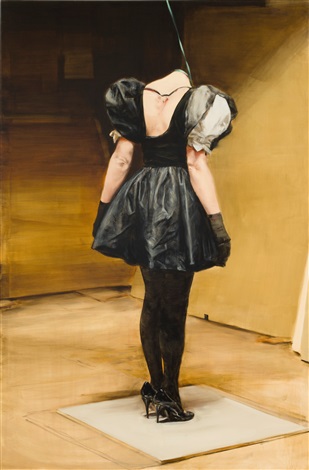
Borremans paints small canvases that feel enormous. His scale is intimate — many works are no larger than an open book — but the psychological weight is overwhelming.
Influences: Velázquez, Manet, and the Old Masters
Look at any Borremans painting and you’ll see the museum behind it. The dark backgrounds, the modeling of skin, the way light falls on fabric — all of it comes from the Spanish and Dutch Golden Age.
Diego Velázquez is the most obvious reference. The same compositional restraint. The same dignity in the figures. The same feeling that something invisible is happening just outside the frame.
Édouard Manet is the second pillar. From him Borremans takes the flatness of paint application, the bold brushwork, the courage to leave parts of the canvas seemingly unfinished.
But here’s the twist — Borremans doesn’t copy. He uses 17th-century technique to paint 21st-century anxieties. His figures wear modern clothes, perform modern absurdities, exist in psychological spaces that Velázquez never imagined.
Recurring Themes and Symbolism in His Paintings
Once you’ve seen a few Borremans works, his vocabulary becomes recognizable:
- Faceless figures — heads turned away, hidden under cloth, or simply painted out
- Strange costumes — dresses that look like sacks, masks, theatrical robes
- Ritualistic gestures — figures performing actions whose meaning is withheld
- Miniature people — tiny figures placed on tables like specimens
- Empty interiors — unsettling, dimly lit rooms with no exit visible
The mood is always the same: silence, suspension, the feeling that you’ve walked into a room a moment after something significant happened. Or a moment before.
Borremans never tells you what’s going on. That’s the point. His work demands that you sit with the discomfort instead of resolving it.
The Most Discussed Works of Michaël Borremans
Several series have defined his reputation over the past two decades.
“The Loan” (2011) — a small canvas of a woman whose head is wrapped in fabric. One of those works that haunts you long after you’ve left the gallery.
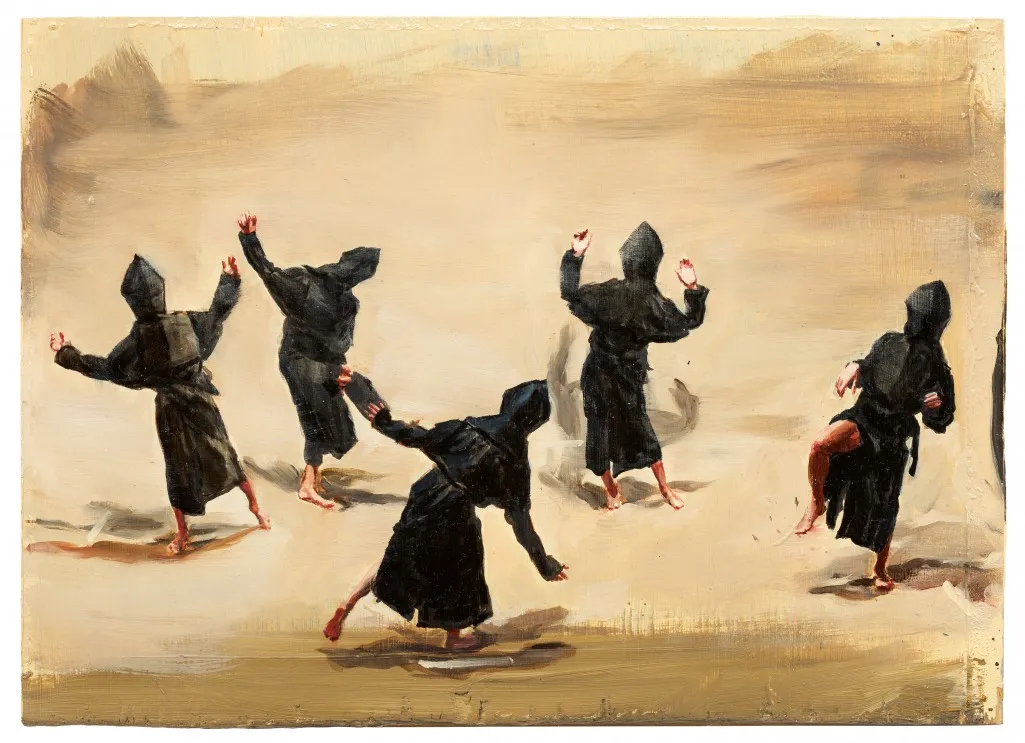
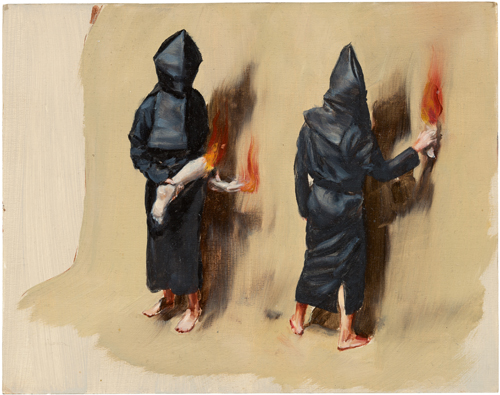
“Black Mould” (2015) — figures in dark hooded robes performing what looks like a private ritual. The series sparked debate about its possible references to extremism, which Borremans denied.
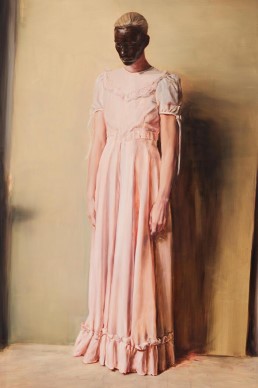
“The Angel” (2013) — a figure in a pale dress with arms outstretched, neither clearly male nor female, neither alive nor dead.
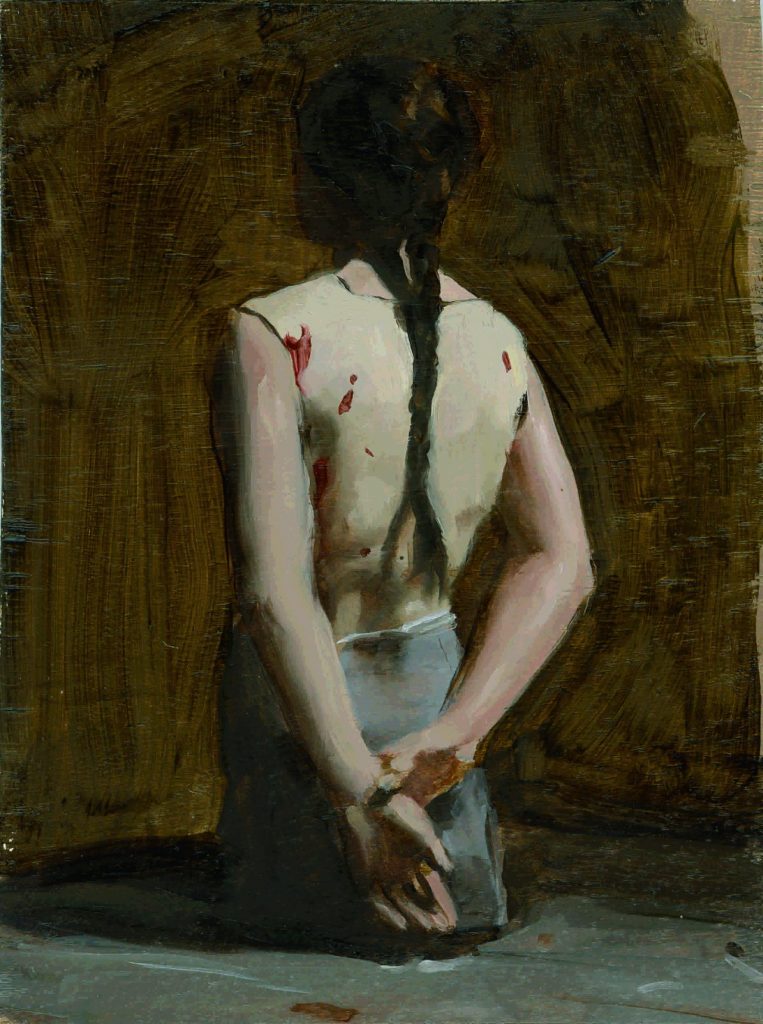
“Automat” series — paintings of stiff, doll-like men in suits, evoking mid-20th-century corporate portraiture stripped of personality.
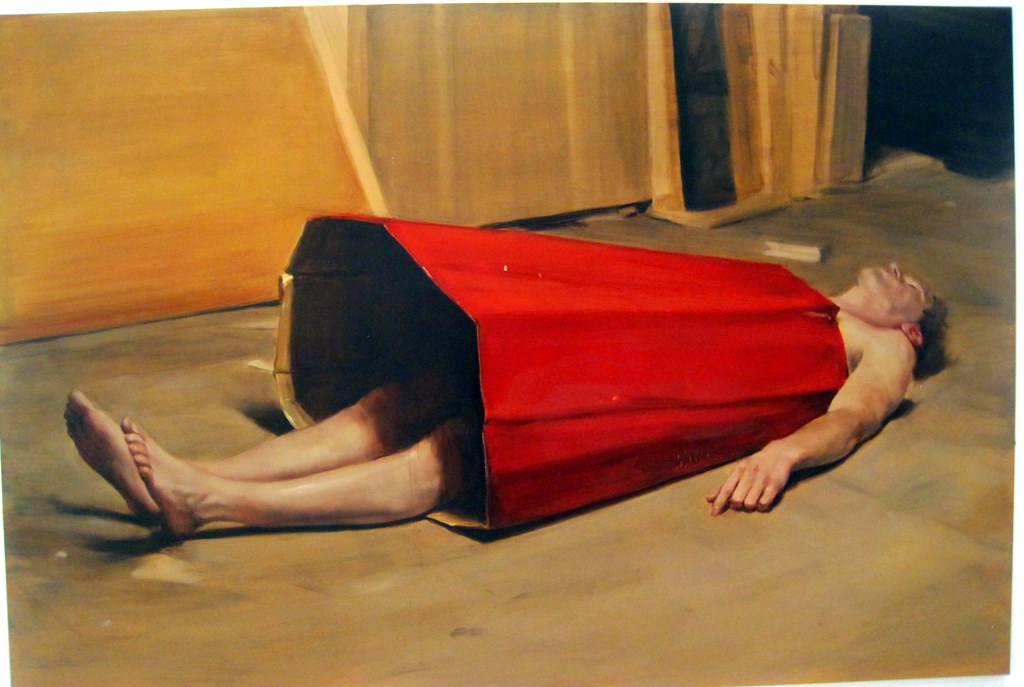
“The Devil’s Dress” (2011) — the painting that pushed his auction prices into seven figures. A woman in an enveloping garment, painted with breathtaking technical precision.
Michaël Borremans: Fire from the Sun — The Most Provocative Series
In 2017, David Zwirner Hong Kong opened a show that became the most controversial moment of Borremans’ career.
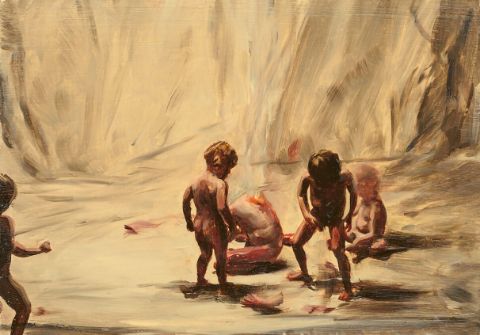
“Fire from the Sun” depicts naked toddlers — chubby, cherubic, painted with unmistakable old-master skill. But they’re covered in red. Smeared with what looks unmistakably like blood. Some clutch dismembered limbs. Others stand alone in empty spaces, staring at nothing.
The reaction was immediate. Some critics called the work a powerful meditation on human cruelty. Others accused the artist of crossing a line.
Borremans himself offered a careful explanation. The series, he said, was about the latent capacity for violence in human beings — the recognition that cruelty isn’t learned but inherent. The reference points were classical: putti from Renaissance painting, biblical scenes of the massacre of innocents, allegories of original sin.
The technique was deliberate. By painting children with the same loving brushwork the Old Masters used for religious subjects, Borremans forced the viewer into a deeply uncomfortable position. You can’t look away. You also can’t quite enjoy looking.
That’s exactly what he wanted.
Michaël Borremans Controversial Art and Public Reaction
“Fire from the Sun” wasn’t an isolated incident. Borremans’ work regularly divides audiences.
The reasons are layered:
| Source of controversy | Example |
|---|---|
| Disturbing subject matter | “Fire from the Sun,” “Black Mould” |
| Refusal to explain | Persistent silence in interviews |
| Beauty applied to dark themes | Old-master technique on uncomfortable subjects |
| Ambiguity of intent | Viewers project meanings the artist never confirms |
His position is consistent: art shouldn’t comfort. It should make you think. If a painting can be reduced to a single message, it has failed.
That stance frustrates some viewers and thrills others. Either way, it keeps the conversation going.
Exhibitions and Institutional Recognition
Borremans’ institutional résumé is dense. The major milestones include:
- BOZAR, Brussels (2014) — “As Sweet as It Gets,” his first major European retrospective
- Dallas Museum of Art (2009) — “Eating the Beard,” US museum debut at this scale
- Tel Aviv Museum of Art (2014) — international touring retrospective
- Palace of Fine Arts, Brussels (2018) — large-scale presentation of new work
- Kunstmuseum Den Haag (2024) — recent solo presentation in the Netherlands
His gallery representation is split between two key partners. David Zwirner handles his international presence, with locations in New York, London, Hong Kong, and Paris. Zeno X Gallery in Antwerp remains his Belgian home and has shown his work since 2002.
His paintings hang in major institutional collections: the Metropolitan Museum of Art, MoMA, the Centre Pompidou, the Hammer Museum, SFMOMA, and the M HKA in Antwerp.
Michaël Borremans Exhibition 2025 and Recent Shows
The artist remains active on the gallery circuit. Recent presentations have continued to explore his ongoing concerns — figures in ambiguous interiors, deliberate compositional restraint, that signature unease.
What to watch for in his current work:
- New iterations of the faceless figure motif
- Continued dialogue with art-historical sources
- Smaller, more intimate canvases alongside occasional larger statements
- Group shows at David Zwirner pairing him with younger figurative painters
For the most accurate exhibition schedule, the David Zwirner and Zeno X websites are the authoritative sources.
Market Value and Collecting Michaël Borremans Painting
Borremans is firmly in blue-chip territory for contemporary figurative painting. His prices have climbed steadily over the past fifteen years, with major works now regularly selling in the seven-figure range.
Notable auction results:
| Work | Year of Sale | Price | Auction House |
|---|---|---|---|
| “The Devil’s Dress” | 2014 | $1.8 million | Christie’s |
| “Sleeper” | 2017 | $1.5 million | Sotheby’s |
| “The Angel” | 2019 | $2.1 million | Christie’s |
| “The German” | 2022 | $1.4 million | Phillips |
Several factors drive value in his market:
- Subject matter — single-figure portraits tend to outperform group scenes
- Period — works from 2008–2015 are particularly sought after
- Size — paradoxically, smaller intimate canvases often command top prices
- Exhibition history — pieces shown at BOZAR or Zwirner museum projects are premium
- Provenance — direct purchase from Zeno X or Zwirner adds confidence
A note for first-time buyers: Borremans’ primary-market works rarely surface publicly. New paintings are typically placed directly with established collectors and institutions. The secondary market — auctions and private dealers — is where most opportunities arise.
Books and Publications on the Artist
For anyone serious about understanding Borremans, the published material is essential. He may not give long interviews, but the catalogues do a lot of the talking.
The Essential Michaël Borremans Book Selection
The most important volumes on the artist:
- “Michaël Borremans: As Sweet as It Gets” (Hatje Cantz, 2014) — the comprehensive monograph published alongside the BOZAR retrospective. The single best starting point.
- “Michaël Borremans: Fire from the Sun” (David Zwirner Books, 2018) — the catalogue documenting the controversial Hong Kong exhibition with essays placing the series in art-historical context.
- “Michaël Borremans: The Duck” (Hatje Cantz, 2011) — focused on his middle-period work, with strong reproductions and critical writing.
- “Michaël Borremans: Eating the Beard” (Hatje Cantz, 2011) — accompanies the Dallas museum exhibition and gathers earlier paintings.
- “Michaël Borremans: Paintings” (Ludion) — Belgian publisher, valuable for collectors of art books focused on Northern European figurative painting.
These are widely available through art-book dealers, museum shops, and online retailers like David Zwirner Books, Hatje Cantz direct, and Idea Books.
Borremans occupies a strange position in contemporary art. He paints like someone from four hundred years ago. He thinks like someone confronting the present moment with no illusions left. The combination is rare, and it’s why his work matters.
His influence is already visible in a younger generation of figurative painters who borrow his palette, his compositional restraint, his willingness to leave meaning unresolved. None of them quite manage what he does — the discomfort, the technical mastery, the refusal to flinch.
Whether you find his work beautiful, disturbing, or both, one thing is clear: Borremans isn’t trying to please you. He’s trying to make you look longer. And in an age of endless scrolling, that might be the most radical thing a painter can do.
Frequently Asked Questions
Michaël Borremans is known for small-scale figurative paintings that combine Old Master technique with deeply unsettling contemporary subjects. His signature elements include faceless figures, theatrical lighting, dark backgrounds, and ambiguous narratives that resist clear interpretation. He’s particularly recognized for the controversial series “Fire from the Sun” (2017) and for his stylistic dialogue with Velázquez and Manet.
Prices vary widely depending on size, period, and subject. Smaller works on the secondary market typically range from $200,000 to $600,000. Major paintings have crossed the seven-figure mark, with works like “The Angel” reaching around $2.1 million at auction. New works from his gallery are usually placed directly with established collectors at undisclosed prices.
Several paintings have sold around the $70 million mark. Notable examples include Mark Rothko’s “Orange, Red, Yellow” ($86.9 million in 2012), Andy Warhol’s “Eight Elvises” (~$100 million private sale), and Francis Bacon’s “Three Studies for a Portrait of John Edwards” ($80.8 million in 2014). The exact figure depends on which specific sale you’re asking about.
Art historians most often point to The Old Guitarist (1903) by Pablo Picasso from his Blue Period — an emaciated blind musician hunched over his instrument, an image of total despair. Other strong contenders include Vincent van Gogh’s Sorrowing Old Man (At Eternity’s Gate), Edvard Munch’s The Scream, and Francisco Goya’s Saturn Devouring His Son.